
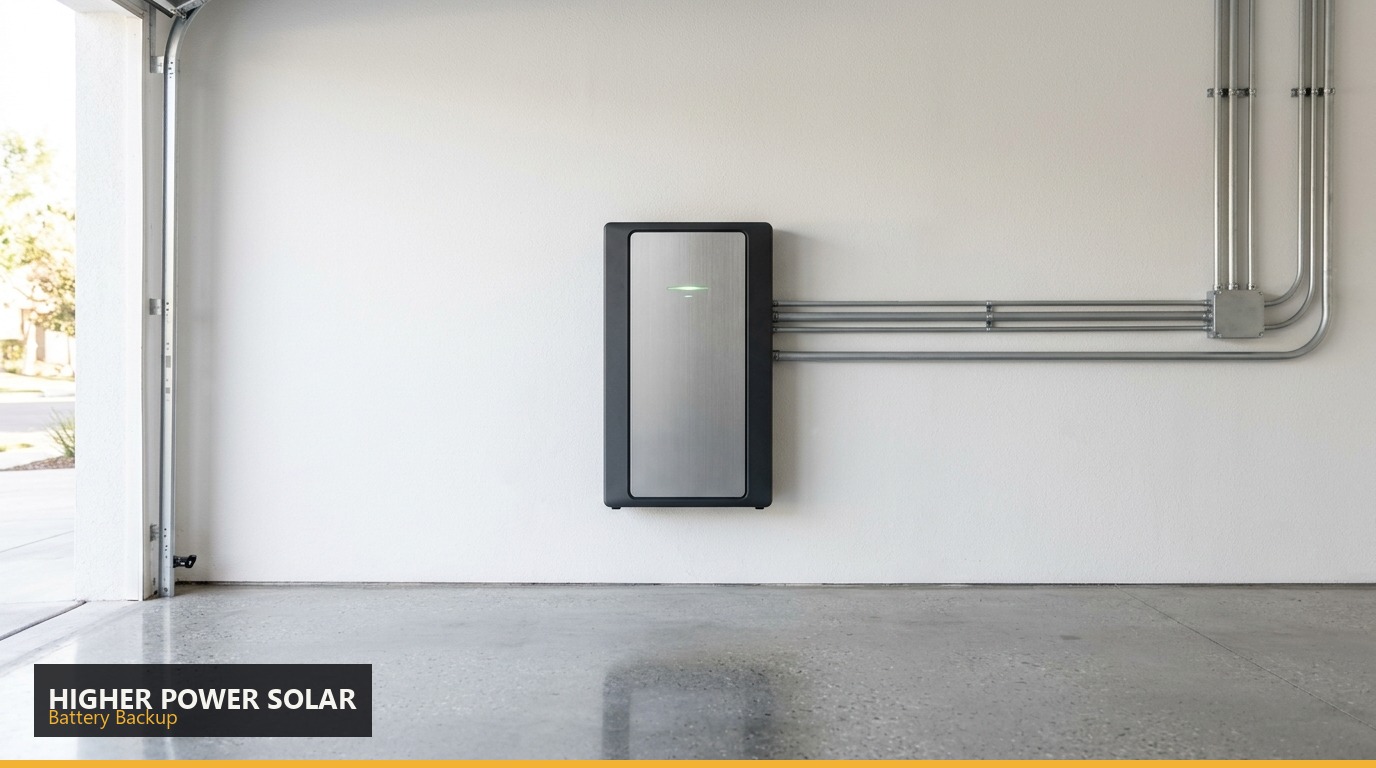
Home battery backup pairs with rooftop solar to keep your essential loads running during a grid outage and — in time-of-use territories like California — to shift solar production from cheap midday hours to expensive peak evening hours. Higher Power Solar installs Tesla Powerwall, Enphase IQ Battery, and FranklinWH systems across Florida, California, and Nevada. This page covers what battery backup actually does, how to size it, what it costs in 2026, and where it pays back fastest.
In San Diego? See home battery & Tesla Powerwall installation in San Diego — SGIP rebates and NEM 3.0 backup.
In North Port or Southwest Florida? See solar + battery backup in North Port — hurricane-season outage protection on FPL, with Powerwall and Enphase systems sized for multi-day storm outages.
What home battery backup gives you
- Outage protection
- A grid-tied solar system shuts off during a utility outage (safety code — your panels can’t back-feed lines that crews may be working on). A solar + battery system disconnects from the grid and powers your essential loads from solar and stored battery capacity.
- Peak shaving (TOU rate plans)
- If your utility charges higher rates during peak hours (typical of SDG&E NEM 3.0 in California and increasingly common in Nevada), a battery lets you store cheap midday solar and discharge during the expensive evening peak — much higher savings than solar alone.
- Self-consumption maximization
- Florida currently retains 1:1 net metering, so peak shaving isn’t a major lever. But for any homeowner whose net metering is reduced or eliminated, batteries are how you keep solar economics attractive.
- Resilience for medical equipment, work-from-home, EV charging
- Homes with medical baseline (oxygen concentrators, dialysis, refrigerated insulin), home offices with hard SLA requirements, or EV charging needs benefit disproportionately from battery backup.
How big a battery do you need?
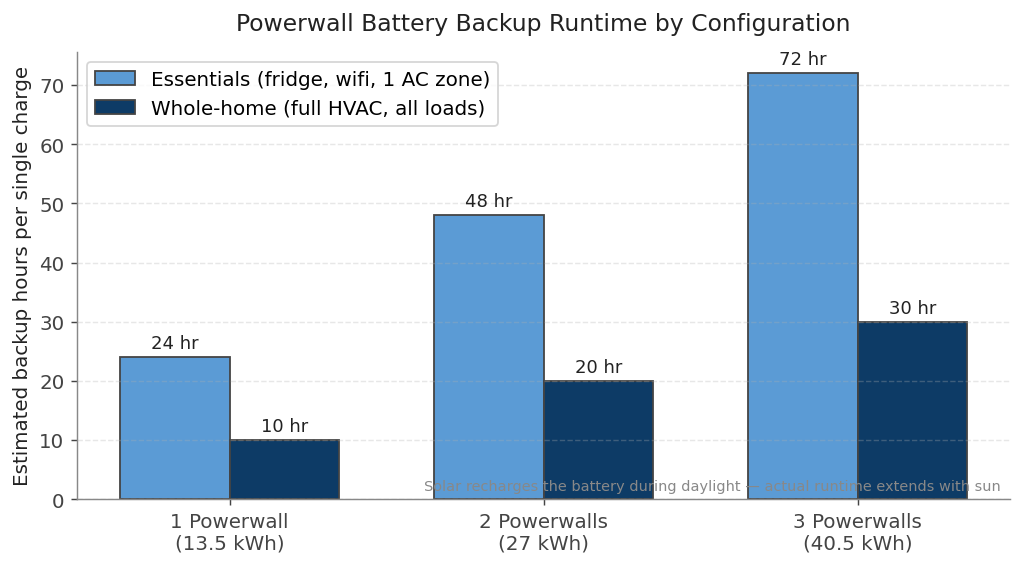
Battery sizing depends on what you want to keep running and for how long. A typical “essentials backup” runs your refrigerator, internet, several lights, and one window or central AC unit. “Whole-home backup” runs everything for a meaningful stretch.
| Backup goal | Typical battery size | Runtime (essentials) | Notes |
|---|---|---|---|
| Essentials, 12–24 hours | 10–13.5 kWh (1 unit) | ~12–24 hours | Most common configuration |
| Essentials, 2–3 days | 20–27 kWh (2 units) | ~36–72 hours | Recommended for hurricane-prone FL |
| Whole-home, 1–2 days | 27–40 kWh (2–3 units) | 1–2 days everything on | Requires whole-home backup hardware |
| Off-grid days during PSPS | 27+ kWh + properly sized solar | Indefinite during sunny days | CA wildfire areas with frequent PSPS |
What battery backup actually costs in 2026
| System | Gross installed cost | 2026 Installed Price (no federal credit for purchases) |
|---|---|---|
| 1 Tesla Powerwall 3 (13.5 kWh) | $13,000–$16,000 | $9,100–$11,200 |
| 2 Enphase IQ 5P (10 kWh total) | $11,000–$14,000 | $7,700–$9,800 |
| 2 Powerwall 3 (27 kWh) | $22,000–$28,000 | $15,400–$19,600 |
| FranklinWH aPower (15 kWh) | $14,000–$17,000 | $9,800–$11,900 |
Through 2025, a 30% federal credit applied to batteries installed with solar; for systems purchased in 2026 that credit has ended (a lease or PPA can still capture it). California’s SGIP rebate stacks on top — see that page for current SGIP tier details.
Where battery backup pays back fastest
- California (NEM 3.0): battery is essentially required — solar alone has a 12–15+ year payback under NEM 3.0; solar + battery typically pays back in 6–9 years.
- Hurricane-prone Florida: Resilience value — avoiding lost food, generator fuel, hotel stays, and business income during a multi-day Hurricane Ian-style outage easily justifies the spend for many homeowners.
- Nevada: battery is currently optional for solar payback (NEM 2.0 still pays 75% of retail for exports), but heat-wave outages and NV Energy’s storage incentive program tip the math for many.
Battery brand comparison
See our dedicated Tesla Powerwall cost page for a deep comparison. Quick summary:
- Tesla Powerwall 3: 13.5 kWh fixed size, integrated solar inverter, 11.5 kW continuous power output. Best for whole-home backup needs.
- Enphase IQ Battery: Modular 5 or 10 kWh increments. Best when paired with existing Enphase microinverters.
- FranklinWH aPower: 15 kWh modular, generator-input ready. Best for off-grid resilience.
Where Higher Power Solar installs batteries
We install across Florida, California, and Nevada. Pick your city for installation specifics:
Frequently asked questions
Will my battery work during a hurricane in Florida? Yes. The battery’s automatic transfer switch disconnects from the grid when utility power is lost and powers your essential loads. With proper sizing, you can ride out multi-day outages on solar + battery alone.
Do you install battery backup in North Port, FL? Yes — North Port is our Southwest Florida home base. After Hurricane Ian’s eyewall crossed North Port in 2022 and Milton followed in 2024, battery backup is the most-requested add-on we install here. A single 10–13 kWh battery keeps a North Port home’s refrigerator, internet, lights, and one AC zone running for 12–24 hours on FPL. See our North Port solar & battery backup page for local specifics.
Can I add a battery to my existing solar system? Usually yes. Powerwall 3 supports AC coupling to most existing solar inverters. We assess your existing system during the site survey.
Does a battery require a main panel upgrade? Often, yes — especially in homes built before 2000 with 100A or 125A panels. Budget $2,500 to $5,000 for an upgrade to 200A if needed.
How long do home batteries last? All major residential batteries carry 10-year warranties with guaranteed capacity retention. Expected useful life is 15–20 years.
Can I install battery backup without solar? Yes, but the math rarely justifies it — without solar to recharge the battery, you only get one cycle of outage protection. Solar + battery is the standard configuration.
Schedule a free battery + solar consultation
Florida: call (941) 830-4937. California / Nevada: call (619) 456-5352. We’ll review your last 12 months of utility usage, walk your roof and electrical panel, and design a battery system sized to your actual backup needs and rate plan.