
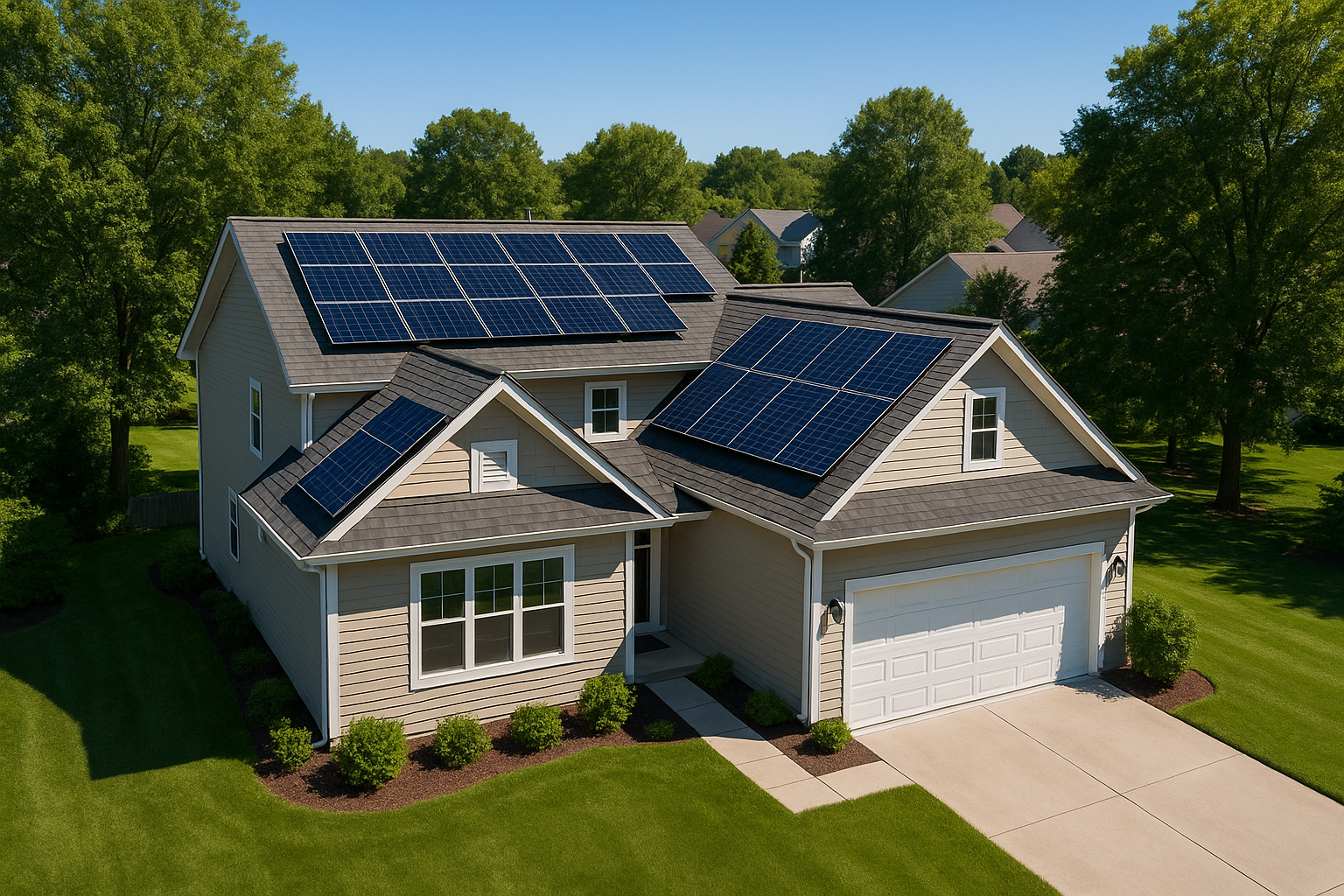
This guide covers everything a homeowner needs to know about installing solar panels on their house in 2026: how the system works, what equipment goes on your roof, how much it costs, how long it takes to pay back, what financing options exist, and how to pick the right installer. Focused on the three states Higher Power Solar serves: Florida, California, and Nevada.
How residential solar works in plain language
Five major components make up a residential solar system:
- Solar panels
- Mounted on your roof, panels convert sunlight to direct-current (DC) electricity. A typical home system has 18–40 panels.
- Inverter
- Converts DC from the panels to AC electricity your home appliances use. Two main types: a single string inverter (located near your electric meter) or microinverters (one per panel, located on the roof).
- Racking
- The metal hardware that attaches panels to your roof. Different mounting for shingle, tile, and metal roofs.
- Monitoring
- A small communications module that sends your production data to a phone app. Lets you see how much electricity your system generates daily.
- Battery (optional)
- Stores excess solar for use at night or during outages. Required for California NEM 3.0 economics; increasingly added in Florida for hurricane backup. See our battery backup guide and Tesla Powerwall cost guide.
How much do solar panels cost for a home?
Pricing is best measured in dollars per watt installed. Typical 2026 residential pricing:
| Region | Cash price ($/watt) | 10 kW system gross | After 30% federal tax credit |
|---|---|---|---|
| Florida | $2.50 – $3.10 | $25,000 – $31,000 | $17,500 – $21,700 |
| California (includes battery for NEM 3.0) | $3.00 – $3.70 | $30,000 – $37,000 | $21,000 – $25,900 |
| Nevada | $2.70 – $3.30 | $27,000 – $33,000 | $18,900 – $23,100 |
For the full cost breakdown by system size, drivers, and financing options, see our 2026 solar panel cost guide.
How much do solar panels save a typical home?
Savings depend on your current electric bill, system size, and how long you keep the system. Quick examples:
| Current monthly bill | System recommended | Annual savings | 25-year savings (assumes 4% utility inflation) |
|---|---|---|---|
| $150 (FPL) | 8 kW solar | $1,800 | $75,000 |
| $250 (FPL or SDG&E) | 10–12 kW solar (+ battery in CA) | $3,000 | $125,000 |
| $400 (SDG&E or peak summer FPL) | 14 kW solar + 10 kWh battery | $4,800 | $200,000 |
| $600+ (large home, EV, pool) | 18+ kW solar + 20 kWh battery | $7,200+ | $300,000+ |
These numbers assume cash purchase. Financing changes the math: with a solar loan, your monthly loan payment is typically similar to your previous utility bill, so cash flow is roughly neutral from day one and the savings accumulate as utility rates rise.
Solar panels: what brand should you choose?
| Tier | Brands | Typical premium vs. budget | Best for |
|---|---|---|---|
| Premium | Maxeon (SunPower), Silfab (Washington, USA) | +$0.20–$0.30/watt | 30-year performance warranty seekers |
| Mainline | Q CELLS (Georgia, USA), REC, Panasonic, Mission Solar (Texas, USA) | +$0.05–$0.15/watt | Most homes — excellent value |
| Budget | JinkoSolar, Longi, Trina | baseline | Lowest upfront cost; shorter warranty |
For most homeowners, mainline panels from a US manufacturer (Q CELLS or Silfab) hit the sweet spot. They qualify for the 10% domestic-content bonus tax credit (effectively reducing their net cost below budget panels) and they come with 25-year warranties from a US-domiciled company.
How long do solar panels last?
Standard residential panel warranties run 25 years on power output, with manufacturers guaranteeing 84–87% of original output at year 25. Real-world degradation is around 0.4–0.6% per year — meaning most panels still produce 80%+ of original output at year 25.
Beyond the 25-year warranty, panels keep working — just at gradually reduced output. Many systems installed in the 1990s are still producing at 70%+ of original output.
What does the install process look like?
- Site assessment (1–2 hours on-site) — installer reviews your roof, electrical panel, and 12 months of utility bills
- Design + quote (3–7 days) — engineering team produces system layout, electrical one-line diagram, and pricing
- Contract + financing (1–2 weeks) — you sign, financing closes if applicable
- Permitting (1–4 weeks) — installer pulls building + electrical permit through your county or city
- Installation (1–3 days on-site) — crew mounts racking, attaches panels, runs wiring, installs inverter
- City inspection (3–14 days after install) — municipal inspector verifies the install meets code
- Utility interconnection (2–6 weeks) — utility verifies and issues Permission to Operate (PTO)
- System turn-on — you start producing your own electricity
End-to-end timeline: 6–14 weeks from contract signing depending on county permit backlog and utility queue.
Net metering: how you get credit for excess solar
Most days, your solar system produces more electricity than your home uses (especially midday). The excess flows backward through your meter to the grid, and your utility credits you. The structure varies by state:
| State | Net metering structure | Credit value |
|---|---|---|
| Florida (FPL) | 1:1 net metering | Full retail rate (~$0.16/kWh) |
| California (SDG&E, PG&E, SCE) | NEM 3.0 (since April 2023) | Wholesale “avoided cost” rate (~$0.05/kWh avg) |
| Nevada (NV Energy) | NEM 2.0 | ~75% of retail rate |
NEM 3.0 in California is why CA solar systems now require batteries to be economic: a battery lets you store excess solar and use it during expensive evening peak hours instead of selling it cheap to the grid at noon.
What about my roof?
Solar panels add weight (~3 lbs per square foot) and require penetrations for racking attachment. Three questions to answer before installing:
- How old is your roof?
- If your roof is more than 15–20 years old, replacing it before solar avoids paying $3,000–$5,000 down the road to remove and reinstall the array when the roof eventually fails. See our roof replacement guide.
- What material is the roof?
- Asphalt shingle, tile, and standing-seam metal all work for solar. Each requires different mounting hardware (flashed L-feet for shingle, tile hooks for tile, S-5! clamps for metal).
- Does the roof structure support the additional weight?
- Almost always yes for modern homes. Older homes or unusual roof structures occasionally need structural reinforcement before install.
Higher Power Solar handles both solar and roofing — if your roof needs replacement, we can do both in one project. See combined solar + roof replacement.
Frequently asked questions
Will solar panels increase my home value? Yes — multiple studies (Lawrence Berkeley National Lab, Zillow) find solar-equipped homes sell for $15,000–$25,000 more on average, and faster than comparable non-solar homes. Florida and California also exempt solar from property tax assessments.
What happens during a power outage? A grid-tied solar system without a battery shuts down during an outage for utility worker safety. Solar + battery (Tesla Powerwall, Enphase IQ Battery, FranklinWH) disconnects from the grid during an outage and powers your essential loads. See our battery backup guide.
Do solar panels work on cloudy days? Yes, just at reduced output. A typical panel produces 10–30% of its rated output on a heavily overcast day. Florida and California get enough sun annually that cloudy days are a small part of the equation.
How much maintenance do solar panels require? Very little. Most systems get rinsed by rain and don’t need professional cleaning more than once every few years. Tracking equipment failures or output drops is what monitoring software does automatically.
Can I install solar panels myself? Technically possible but rarely worth it. DIY voids most panel manufacturer warranties, your utility won’t interconnect a non-licensed install, and the IRS requires a tax credit to be tied to a permitted install. Labor is roughly 15–20% of total cost.
What if I move? Solar systems typically transfer with the home and add to resale value. Solar loans transfer (the new homeowner assumes the loan, or you pay it off at closing from sale proceeds). Solar leases sometimes transfer, sometimes don’t — one reason ownership beats leasing.
Should I wait for solar to get cheaper? Solar costs have stabilized in recent years (some categories have actually risen due to tariffs). The federal 30% tax credit is extended through 2032 but eventually phases out. Waiting another year typically just costs you another year of utility bills.
Get a quote for your home
Higher Power Solar installs in Southwest Florida (Charlotte, Sarasota, Lee counties), San Diego County, and the Las Vegas metro. Call (619) 456-5352 or schedule a free in-home consultation. We’ll pull your last 12 months of utility bills, walk your roof, and produce a written line-item quote within 7 days.
Service area
Get a free in-home quote in your city:
- North Port, FL
- Port Charlotte, FL
- Punta Gorda, FL
- Venice, FL
- Englewood, FL
- Fort Myers, FL
- Sanibel, FL
- Osprey, FL
- Warm Mineral Springs, FL
- Rotonda West, FL
- La Jolla, CA
- La Mesa, CA
- Mira Mesa, CA
- Clairemont, CA
- Del Mar, CA
- Rancho Bernardo, CA
- Rancho Santa Fe, CA
- Santee, CA
- Poway, CA
- Las Vegas, NV
Related guides
- Real solar panel costs by state in 2026
- American-made solar panels: Q CELLS, Silfab, and others
- Tesla Powerwall cost and alternatives
- California solar incentives 2026 (NEM 3.0, SGIP)
- FPL cost per kWh: rate structure and history
- Solar financing: cash vs loan vs lease
- How to choose the best solar installer
- Sunrun alternative comparison