
Florida Power & Light (FPL) is the largest electric utility in Florida, serving roughly 5.8 million accounts across the state. If you live in Sarasota, Charlotte, Lee, or Collier County south of Tampa, there’s a strong chance FPL is your utility. This page breaks down what FPL actually charges per kilowatt-hour, how the residential bill is structured, why your bill keeps creeping up, and how a properly sized rooftop solar system offsets the largest line items.
What does FPL charge per kWh in 2026?
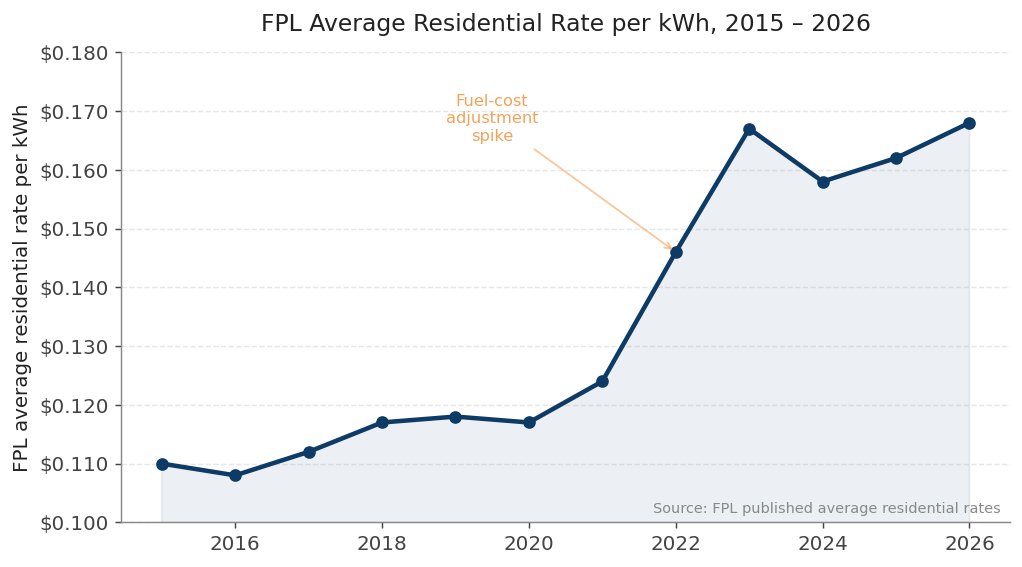
A typical FPL residential bill in 2026 has a total effective rate of roughly $0.15 to $0.18 per kilowatt-hour when you add up all the line items. That’s the all-in cost — the number that matters when you’re comparing your power bill to the cost of solar production. The published “base rate” on FPL’s tariff is lower than that, but the base rate isn’t what you pay. The actual rate includes several charges layered together. Here’s the breakdown.
The line items on a typical FPL residential bill
- Base Energy Charge. The core per-kWh rate set by the Florida Public Service Commission. This covers FPL’s cost of generating and delivering electricity under its normal operating conditions.
- Fuel Charge. A pass-through of the cost of natural gas, coal, and oil that FPL burns at its plants. This is the line item that swings the most year to year — when natural gas prices spiked in 2022, the fuel charge nearly doubled.
- Storm Charge. Recovery of money FPL spent rebuilding the grid after Hurricane Ian, Idalia, Helene, Milton, and other recent storms. This is approved in tranches and shows up as a small but persistent surcharge.
- Conservation, Capacity, and Environmental adjustments. Smaller pass-through line items for state-mandated programs and infrastructure investments.
- Customer Charge. A flat monthly fee (roughly $10–$25 depending on rate plan) that you pay even if you used zero kWh that month.
- Taxes and franchise fees. County and municipal taxes added on top, typically 6–10% of the subtotal depending on where you live.
Together, these come out to roughly $0.15–$0.18 per kWh. If your last 12 months of bills averaged closer to $0.20 per kWh, that’s almost certainly due to seasonal fuel-charge spikes and storm recovery, not a rate change you missed.
Put in plain terms: the average Florida electric bill runs roughly $130-$180 a month for a typical single-family home, and most of that is the Florida Power & Light cost per kWh multiplied by how much you use in Florida’s long cooling season. The more you run the AC, the more the per-kWh rate matters – which is exactly why rooftop solar pays back faster here than in cooler states.
Why your FPL bill keeps going up
Three things are pushing FPL residential bills higher each year:
- Natural gas exposure. FPL generates the majority of its electricity from natural gas. When wholesale gas prices rise, the fuel charge rises with them, and that flows straight to your bill within months.
- Storm hardening and grid rebuild costs. Hurricane Ian alone caused billions of dollars in damage to FPL’s transmission and distribution infrastructure. Those costs are recovered from ratepayers over several years through storm and capacity surcharges.
- Cooling load growth. Florida summers are hotter and longer than they were a decade ago. The average single-family home in Southwest Florida runs its air conditioning roughly 50% more hours per year than it did in 2010 — which means even at flat rates, total bills go up.
None of these are reversing. FPL has filed for additional base-rate increases in 2026, and the storm-recovery surcharge is locked in for several more years.
How rooftop solar offsets FPL charges
Every kilowatt-hour your solar system produces is one kilowatt-hour you don’t buy from FPL — at the full all-in rate of $0.15–$0.18 per kWh. Under Florida’s net metering rules (currently still 1:1 retail credit for residential solar customers), kilowatt-hours you export to the grid in the middle of the day offset kilowatt-hours you pull back in the evening, on a one-for-one basis within the monthly billing cycle.
A typical 10 kW rooftop solar system in Sarasota or Charlotte County produces roughly 13,000–15,000 kWh per year. At today’s FPL all-in rates, that’s $1,950–$2,700 per year in bill offset. Combined with the 30% federal solar tax credit (extended through 2032), Florida’s sales-tax exemption on solar equipment, and Florida’s property-tax exclusion (you don’t pay property tax on the increased home value from solar), most systems pay for themselves in 6–9 years and continue producing for another 20+ years after that.
See what systems look like on homes near you: solar in North Port and solar in Port Charlotte.
The line items solar does NOT offset
Solar only offsets the per-kWh charges. The customer charge — the flat monthly fee around $10–$25 — stays even when you generate as much as you use. So a solar system designed to fully offset your bill will leave you with a small “minimum bill” charge each month, not zero. That’s normal and expected.
Battery backup and FPL outages
FPL’s grid is generally reliable until a storm. Southwest Florida sees the largest outages of any region in the state — Hurricane Ian left some neighborhoods without power for weeks. A solar-only system shuts down during a grid outage (required by safety code), but a solar + battery system disconnects from the grid and powers your essential loads from solar and stored battery capacity. For most FPL customers, one Enphase IQ Battery or Tesla Powerwall (10–13 kWh) covers refrigerator, internet, lights, and a window AC unit for 12–24 hours. We cover this in more detail on our Tesla Powerwall cost guide.
Want the lights on through the next outage? See our battery backup options.
Frequently asked questions
How do I find FPL’s price per kWh on my bill?
Your FPL price per kWh isn’t one line – the FPL kWh price combines the base energy charge plus fuel and other per-kWh riders, which together run about $0.15-$0.18 per kWh in 2026. To get your true cost per kWh from FPL, divide your total bill by the kWh used that month. The average power bill in Florida lands around $130-$180 for a typical home, most of it usage-based – exactly the part solar offsets.
What is the average Florida electric bill?
The average Florida electric bill is roughly $130-$180 per month for a typical home, though it swings higher in summer when cooling load peaks. Your bill is driven by the Florida Power & Light cost per kWh times your usage, plus fixed fees solar can’t offset.
What is Florida Power & Light’s cost per kWh in 2026?
FPL’s all-in residential rate runs about $0.15-$0.18 per kWh once fuel, base, and surcharge line items are combined – and it has trended up year over year. Rooftop solar with 1:1 net metering offsets the usage-based portion of that rate.
Is FPL’s net metering going away? Florida’s legislature has debated changing residential net metering rules several times in recent years. As of early 2026 the 1:1 retail credit is still in place for systems installed today. Systems installed before any future change are typically grandfathered for 20 years.
Do I need to switch off FPL when I go solar? No. You stay an FPL customer, and your home stays connected to the grid. Solar simply offsets what you would have purchased from FPL.
What’s the average FPL bill in Sarasota or Charlotte County? The all-Florida average residential bill in 2025 was around $150–$170 per month, but SW Florida bills run higher because of the cooling load — many homes here see $200–$350 in summer months. A 10 kW solar system zeroes most of that out.
Does solar work with FPL’s time-of-use rate plans? Yes, and many homeowners save more on time-of-use because solar production overlaps with the late-morning and early-afternoon high-cost windows.
Local service area
Higher Power Solar serves FPL customers across Southwest Florida. See our city-specific pages for North Port, Port Charlotte, Rotonda West, Venice, Punta Gorda, Englewood, and the rest of our SW Florida coverage area.
Get a free FPL bill review and solar quote
Call (941) 830-4937 and we’ll pull your last 12 months of FPL usage, calculate your exact all-in rate, and design a solar system sized to offset your bill. No high-pressure sales — just honest numbers.
FPL Service Areas We Cover
Higher Power Solar is an FPL-certified solar installer across Southwest Florida. Get a free in-home quote with our local team for your city: