

California has the highest electric rates of any major U.S. state and one of the strongest sets of solar incentives. The combination should make solar an obvious choice — and for most homeowners it still is — but the rules changed in a big way in 2023, and a lot of pre-2023 advice you’ll find online is now stale. This page lays out every incentive a California homeowner can actually claim in 2026, what changed with NEM 3.0, and how the financial picture works today.
The headline: NEM 3.0 changed solar economics, and storage is now central
From the launch of net metering in California through April 2023, residential solar exports were credited at the full retail rate (“NEM 1.0” and “NEM 2.0”). Under the current program — formally called the Net Billing Tariff but universally known as NEM 3.0 — exports are credited at roughly the wholesale “avoided cost” rate, typically $0.04–$0.08 per kWh. Meanwhile imports at peak hours (typically 4–9 PM) cost $0.40+ per kWh on a typical SDG&E or PG&E TOU rate plan.
What that means in practice: solar alone has a much longer payback now. Solar paired with a battery (Powerwall, Enphase IQ Battery, or similar) pays back in roughly the same window as it always did, because the battery lets you store cheap midday solar and discharge during the expensive evening peak. NEM 3.0 didn’t kill California solar — it killed solar-alone designs and made solar + battery the standard recommendation.
The incentives still available in 2026
1. Federal Solar Investment Tax Credit (ITC) — ended for 2026 purchases
The largest single incentive. Homeowners who purchase a solar system (cash or loan, not lease/PPA) can claim a tax credit equal to 30% of total system cost on their federal tax return. The 30% residential rate ended after 2025 — there is no federal credit for purchased systems in 2026. The credit applies to:
- Solar panels and inverters
- Installation labor
- Permitting fees
- Batteries (Powerwall, Enphase, etc.) — if installed with solar, or within a year before/after
- The portion of roof costs that’s structurally required to support the array (when the install requires roof work)
It’s a non-refundable credit — meaning it can zero out your federal tax liability but won’t generate a refund beyond that. Unused credit rolls forward to future years.
2. Self-Generation Incentive Program (SGIP)
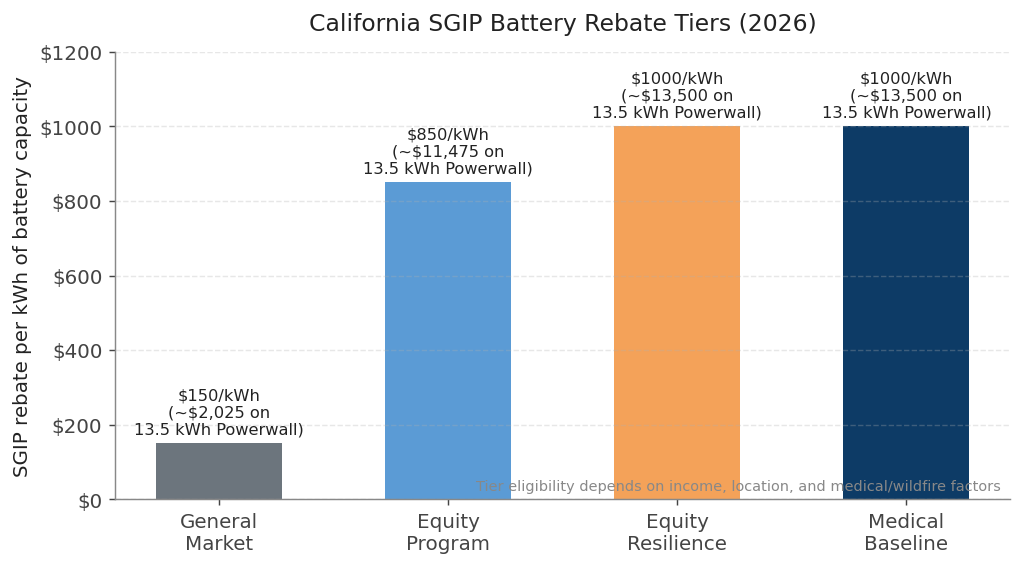
SGIP is California’s battery storage rebate program, funded through ratepayer surcharges. Tiers as of 2026:
- General Market Residential. Roughly $150–$200 per kWh of installed battery capacity. For a 13.5 kWh Powerwall, that’s about $2,000–$2,700 back.
- Equity Resilience. Approximately $1,000 per kWh — meaningful — for income-qualified homeowners in high fire-risk districts, on medical baseline rates, or in low-income areas. Was stackable with the federal ITC, which ended for systems purchased in 2026.
- Equity Budget. Roughly $850 per kWh for income-qualified homeowners outside the Equity Resilience tier.
SGIP rebates come from a fixed pool of money allocated in waves; once a tier exhausts its budget, no new applications are accepted until the next tranche opens. Higher Power Solar reserves your SGIP allocation at contract signing so you’re in the queue before installation completes.
3. California Property Tax Exclusion (Active Solar Energy System Exclusion)
Installing solar increases your home’s appraised market value — but California specifically excludes solar from property tax reassessment through the Active Solar Energy System Exclusion. That exclusion is currently set to sunset on January 1, 2027, but has been extended several times before. Homeowners who install before the sunset are typically grandfathered.
4. SASH and DAC-SASH (Low-income solar programs)
Single-family Affordable Solar Homes (SASH) and the Disadvantaged Communities version (DAC-SASH) provide direct incentives — sometimes covering most of the system cost — for income-qualified homeowners in PG&E and SCE territory. SDG&E has its own equivalent through the Equity programs. These have limited annual funding and waiting lists.
5. Utility-specific battery and EV programs
SDG&E, PG&E, and SCE all run small additional programs in 2026 for battery storage and managed EV charging. These are typically $200–$500 incentives — not life-changing, but worth claiming.
What CA solar costs in 2026 after all incentives
A typical 8 kW solar + 13.5 kWh Powerwall install in San Diego County in 2026 runs approximately:
- Gross installed cost: $35,000–$45,000
- Less federal ITC (not available for 2026 purchases): –$10,500 to –$13,500
- Less SGIP General Market: –$2,000 to –$2,700
- Net out-of-pocket: roughly $22,000–$30,000
At SDG&E’s current peak TOU rates and typical residential consumption, that system displaces $3,500–$5,000 per year of grid electricity costs — putting payback in the 6–9 year window. Solar panels and batteries carry 25-year and 10-year warranties respectively, so the second half of the system’s life is essentially free electricity.
Common questions about CA solar in 2026
Should I wait for NEM 4.0? No public proposal for a new NEM 4.0 exists in 2026. NEM 3.0 is the framework today and customers who interconnect under it are grandfathered for 9 years.
What about the Inflation Reduction Act? The 30% federal residential ITC (Section 25D) ended December 31, 2025 under the One Big Beautiful Bill Act, so there is no federal credit for systems you buy in 2026. That’s the same credit referenced above. No additional federal residential solar credit exists today.
Can I lease or PPA instead of buying? Yes, but you don’t get the federal ITC — the leasing company does. Lease/PPA can still make sense for homeowners who don’t have the tax liability to use the ITC themselves, but for most California homeowners, ownership wins.
What if my house is in a wildfire area with PSPS shutoffs? Battery backup becomes a primary justification. SDG&E and PG&E pre-emptively shut off power during high-wind, high-fire-risk weather. A solar + battery system disconnects from the grid and powers your essential loads through the PSPS event. Equity Resilience SGIP specifically targets these areas with the highest rebate tier.
Do I need to upgrade my electrical panel? Often, yes — especially in homes built before the 2000s. A 100A or 125A panel may need to upgrade to 200A to support the battery. Budget $2,500–$5,000 for that if the existing panel isn’t already at 200A.
San Diego service area
Higher Power Solar installs solar + battery systems across San Diego County, including La Mesa, Rancho Santa Fe, Mira Mesa, Clairemont, Del Mar, La Jolla, Rancho Bernardo, and Santee.
Get a NEM 3.0-aware proposal
Call (619) 456-5352 and we’ll model your home’s specific SDG&E TOU rate, design a solar + battery system sized for NEM 3.0 economics, and confirm your SGIP tier eligibility. Free in-home consultation.
California Service Areas
Higher Power Solar installs NEM 3.0-optimized solar + battery systems across San Diego County. Free in-home consult in any of these cities: