
“How much does a Tesla Powerwall cost?” and “how much does Powerwall 3 cost?” are the two questions we hear most from homeowners researching battery backup. The honest answer is that the headline price you see on Tesla’s website is not what you’ll pay: real installed cost varies based on your panel configuration, whether you’re adding it to an existing solar system or a new install, and what state you’re in.
Quick answer: a single Tesla Powerwall 3 costs roughly $13,000–$16,000 installed in 2026, or about ,000–,000 installed in 2026 (the 30% federal credit ended for purchases; a lease or PPA can still capture it) when installed with solar. Add it to a new solar install and the incremental cost drops to $9,000–$12,000. Each additional Powerwall runs $7,000–$9,000. Full breakdown below.
This page lays out what the Powerwall actually costs in 2026, what drives the price up or down, and how it compares to the main alternative (Enphase IQ Battery).
San Diego homeowner? See home battery installation in San Diego — SGIP rebates can cover most of the cost.
Weighing a solar roof against panels? See Tesla Solar Roof vs. solar panels + a new roof — real 2026 costs and when each wins.
Tesla Powerwall 3 — installed price in 2026
The current model is the Powerwall 3, released in early 2024. It has a usable capacity of 13.5 kWh and an integrated solar inverter. Real-world installed pricing in 2026 looks like this:
- Single Powerwall 3 installed: roughly $13,000–$16,000 in most U.S. markets, before incentives.
- Powerwall 3 paired with a new solar system: often $9,000–$12,000 incremental on top of the solar cost, because much of the install labor and electrical work is shared.
- Each additional Powerwall 3 (expansion): roughly $7,000–$9,000 — cheaper per unit because the inverter and main installation are already done.
Through 2025 the 30% federal solar tax credit applied to the Powerwall (it ended for 2026 purchases; a lease or PPA can still capture it) as long as it’s installed alongside solar (or within a year before or after a solar install). That brings the effective single-Powerwall cost down to roughly ,000–,000 installed in 2026 (the 30% federal credit ended for purchases; a lease or PPA can still capture it).
What drives the installed price up or down
The biggest variables are:
- Main panel upgrade. If your home’s electrical panel is at or near capacity (common in homes built before the 2000s), you’ll need a service upgrade — typically $2,500–$5,000 — before the Powerwall can be installed. This is the single biggest cost surprise we see.
- Backup configuration. Powerwall can back up your entire panel (“whole-home backup”) or a smaller critical-loads subpanel. Whole-home is more flexible but requires a larger battery and/or load-shedding hardware. Critical-loads is cheaper and fine if your goal is just “fridge, internet, lights, one AC zone.”
- Permit and inspection costs. These vary by jurisdiction. In Florida this typically runs $300–$700; in California it can be substantially higher.
- Existing solar inverter compatibility. If you have an older string inverter or non-Tesla microinverters, the Powerwall 3 install requires an AC-coupled configuration which adds some cost.
How a Powerwall actually pays for itself
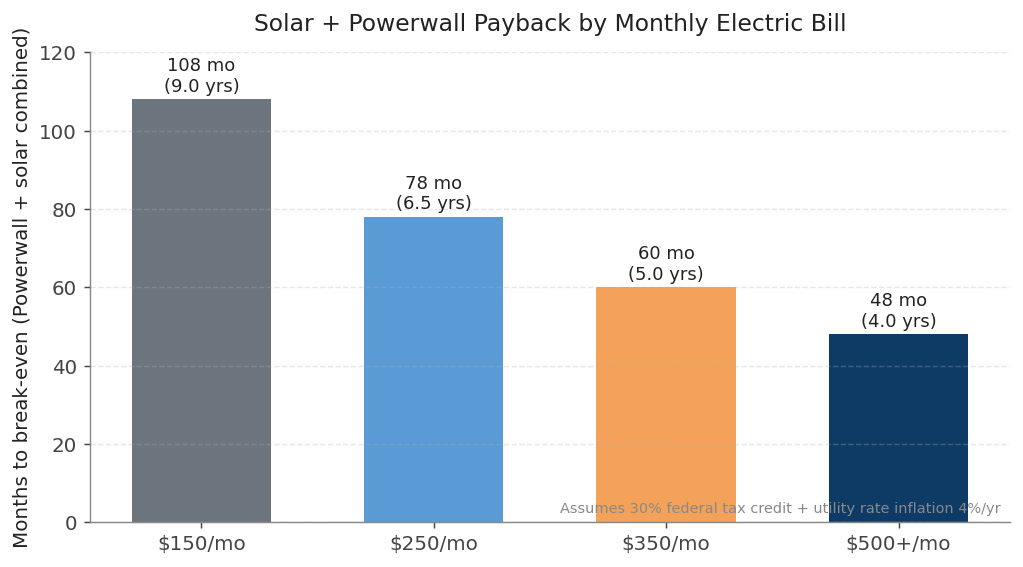
Battery payback math depends heavily on your state. In Florida, the math is mostly about hurricane resilience: the Powerwall doesn’t dramatically reduce your bill (since Florida currently allows 1:1 net metering, so you can already “store” excess solar in the grid). The financial value is in avoiding the cost of a multi-day outage — lost food, generator fuel, hotel stays, business income.
In California, the math is much sharper. After the April 2023 NEM 3.0 changes, solar exports to the grid are paid at roughly $0.05/kWh while peak imports cost $0.40+/kWh. A Powerwall stores your midday solar production and discharges during the 4–9 PM peak — bridging that gap. Most California homeowners now see a Powerwall + solar payback in 6–9 years, where solar-alone payback under NEM 3.0 is 12–15+ years. See our California solar incentives page for full details.
Comparing whole-home options? Start with our battery backup guide.
Tesla Powerwall vs Enphase IQ Battery
The two dominant residential batteries in 2026 are the Tesla Powerwall 3 (13.5 kWh, integrated inverter) and the Enphase IQ Battery (typically the IQ 5P, 5 kWh, or stacked in pairs for 10 kWh). Quick comparison:
- Size flexibility. Enphase is modular — you can install one 5 kWh unit or stack several. Powerwall comes in 13.5 kWh increments only. For a small starter battery, Enphase is more flexible.
- Power output. Powerwall 3 delivers 11.5 kW continuous, which can start large loads like a central AC. Enphase IQ 5P delivers 3.84 kW per unit, so you typically need two or three to start a large AC.
- Solar inverter integration. Powerwall 3 has the solar inverter built in. Enphase pairs naturally with Enphase microinverters (which we install on many solar projects).
- App and monitoring. Both have polished mobile apps. Tesla’s is generally considered slightly better for daily use; Enphase’s is better for system diagnostics.
- Warranty. Both 10 years, both with capacity retention guarantees. Comparable.
- Lead time. Powerwall 3 supply has improved significantly in 2026 and lead times are now typically 4–8 weeks. Enphase is similar.
There’s no clean “winner.” We install both depending on the home’s solar configuration, the homeowner’s backup goals, and lead times.
Tesla Powerwall installer near you: rebates and pairing with solar
Choosing a Tesla Powerwall installer matters as much as the battery. A certified installer handles the SGIP rebate paperwork, sizes the system to your utility’s time-of-use peaks, and AC-couples the Powerwall to your existing inverter when you’re adding solar with a Tesla battery retrofit. In California, a Powerwall installed with solar qualified for the 30% federal tax credit through 2025 (ended for 2026 purchases), and many homes also qualify for an SGIP Tesla Powerwall rebate of $150-$1,000 per kWh – far higher on fire-risk circuits. We pull your usage, confirm your SGIP tier, and quote the installed Powerwall price after every incentive you qualify for. See our San Diego home battery page for local rebate detail.
We install Powerwall across Southwest Florida — see North Port and Port Charlotte.
Frequently asked questions
Who can install a Tesla Powerwall near me?
A licensed solar or electrical contractor experienced with battery storage. As a Tesla Powerwall installer, Higher Power Solar handles the install, the SGIP rebate application, and the utility interconnection – whether it’s a new solar-plus-Powerwall system or a battery added to existing solar.
Is there a rebate for the Tesla Powerwall?
Yes. With solar, the Powerwall qualified for the 30% federal tax credit through 2025 (ended for 2026 purchases), and California’s SGIP program adds a per-kWh battery rebate that can cover most of the cost on high fire-risk circuits. We confirm your exact rebate during the proposal.
Will one Powerwall run my whole house? Probably not for long periods. A single 13.5 kWh Powerwall covers essentials (fridge, internet, lights, one AC zone) for 12–24 hours of typical Southwest Florida summer use. Whole-home for several days typically requires two or three Powerwalls plus a properly sized solar array.
Can I add a Powerwall to my existing solar system? Yes — Powerwall 3 supports AC coupling to existing solar inverters from most manufacturers. We do this routinely.
Is the Powerwall worth it without solar? Generally no in Florida — the only benefit without solar is a few hours of grid-outage protection, and the math rarely justifies it. With solar, the value is real (resilience in FL, peak shifting in CA).
Does the Powerwall still qualify for a federal tax credit in 2026? Yes, as long as it’s installed alongside solar or within a year of a solar install. Without solar, the credit doesn’t apply.
What about SGIP in California? California homeowners can stack the federal credit with SGIP (Self-Generation Incentive Program), which pays roughly $150–$1,000 per kWh of battery capacity depending on tier. See our California solar incentives page.
Cost by Household Usage
Tesla Powerwall is sized by your daily kWh usage and how many essentials you want to run during an outage. Here is what a typical Florida or California household pays installed in 2026 (installed in 2026 (federal credit no longer applies to purchases)):
| Monthly Electric Bill | Recommended System | Installed Cost (gross) | 2026 Installed Price (no federal credit for purchases) |
|---|---|---|---|
| Under $150 | 1 Powerwall 3 (13.5 kWh) | $15,000 – $17,500 | $10,500 – $12,250 |
| $150 – $300 | 2 Powerwall 3 (27 kWh) | $26,000 – $30,000 | $18,200 – $21,000 |
| $300 – $500 | 3 Powerwall 3 (40.5 kWh) | $36,000 – $42,000 | $25,200 – $29,400 |
| Over $500 | 4+ Powerwall 3 (54+ kWh) | $45,000+ | $31,500+ |
Ranges reflect installation complexity: panel upgrades, run distance to the main service panel, integration with existing solar, and permit fees vary by jurisdiction.
Tesla Powerwall vs FranklinWH vs Enphase — detailed comparison
| Feature | Tesla Powerwall 3 | FranklinWH aPower 2 | Enphase IQ 5P |
|---|---|---|---|
| Usable capacity (per unit) | 13.5 kWh | 15 kWh | 5 kWh |
| Continuous power output | 11.5 kW | 10 kW | 3.84 kW |
| Built-in solar inverter | Yes (PV3 module) | No (uses your existing) | No (microinverter compatible) |
| Whole-home backup | Yes (most homes) | Yes | No (essentials only) |
| Stackable | Up to 4 | Up to 15 | Up to 16+ |
| Warranty | 10 years | 15 years | 15 years |
| App-based monitoring | Tesla app | FranklinWH app | Enphase Enlighten |
| Installed cost (single unit) | $15,000 – $17,500 | $16,500 – $19,000 | $5,500 – $7,000 |
Powerwall warranty and lifespan
Tesla covers Powerwall 3 with a 10-year unlimited-cycle warranty. Tesla guarantees that the battery will retain at least 70% of its capacity at year 10. In practice, real-world degradation data from Powerwall 1 and 2 owners shows about 1–2% capacity loss per year, meaning most units retain 80–85% capacity at year 10. After warranty, the battery still works — just with reduced storage.
The 10-year window is short compared to Enphase (15 years) and FranklinWH (15 years), which is the single biggest knock against Powerwall. Whether that matters depends on whether you plan to be in the home that long.
Service area
Higher Power Solar installs Tesla Powerwall and Enphase IQ Battery systems in Southwest Florida (North Port, Port Charlotte, Venice, Punta Gorda, and surrounding cities) and San Diego County (La Mesa, Mira Mesa, Rancho Bernardo, and more).
Get a real Powerwall quote
Florida: call (941) 830-4937. California: call (619) 456-5352. We’ll walk your panel, check for any service-upgrade needs, and give you a real installed price for your home — not a generic website estimate.
Tesla Powerwall Installation Service Area
Higher Power Solar installs Tesla Powerwall and Powerwall+ in Florida, California, and Nevada. Free site assessment in any of these cities: