
Solar panel costs in 2026 break down differently than most online calculators suggest. The price of a single panel is irrelevant — what matters is the all-in installed system cost (panels + inverter + racking + electrical work + permit + utility interconnection). This guide gives real 2026 installed prices for the three states Higher Power Solar serves: Florida, California, and Nevada.
What a solar panel actually costs in 2026
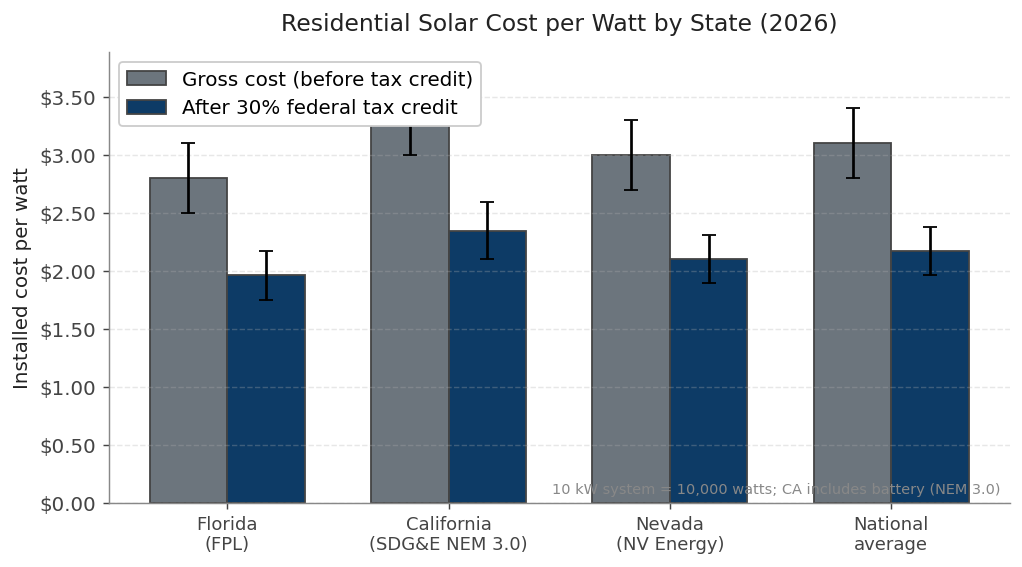
The industry price metric is dollars per watt installed. A typical residential system in 2026 runs:
| Region | Cash price ($/watt installed) | What a 10 kW system costs | After 30% federal tax credit |
|---|---|---|---|
| Florida (FPL, LCEC service areas) | $2.50 – $3.10 | $25,000 – $31,000 | $17,500 – $21,700 |
| California (SDG&E, PG&E, SCE) | $3.00 – $3.70 | $30,000 – $37,000 | $21,000 – $25,900 |
| Nevada (NV Energy) | $2.70 – $3.30 | $27,000 – $33,000 | $18,900 – $23,100 |
| National average | $2.80 – $3.40 | $28,000 – $34,000 | $19,600 – $23,800 |
California runs about 15% higher than Florida because of NEM 3.0 design requirements — most CA homes now need solar paired with a battery to make the math work, which adds $10,000–$15,000 to the install. Nevada and Florida still allow grid-tied solar without a battery, keeping the entry price lower.
Cost by system size
| System size | Approx. annual production | Typical bill it offsets | Installed cost (Florida) | After 30% tax credit |
|---|---|---|---|---|
| 5 kW (15 panels) | 7,000 kWh | $95/month FPL | $13,500 – $16,000 | $9,450 – $11,200 |
| 8 kW (24 panels) | 11,200 kWh | $150/month FPL | $20,500 – $24,500 | $14,350 – $17,150 |
| 10 kW (30 panels) | 14,000 kWh | $190/month FPL | $25,000 – $31,000 | $17,500 – $21,700 |
| 12 kW (36 panels) | 16,800 kWh | $225/month FPL | $29,500 – $36,500 | $20,650 – $25,550 |
| 15 kW (45 panels) | 21,000 kWh | $280/month FPL | $36,500 – $45,000 | $25,550 – $31,500 |
System size is determined by your last 12 months of utility usage (kWh), not your home’s square footage. We pull your FPL, LCEC, NV Energy, or SDG&E bills before sizing.
What drives cost up or down
- Panel brand
- Premium American-made panels (Q CELLS, Silfab) add $0.10–$0.25/watt vs. budget overseas panels. Premium typically buys longer warranty (25-year product warranty vs. 12-year) and better degradation guarantees. See our American-made solar panels guide.
- Roof type
- Asphalt shingle is the cheapest to install on. Tile adds $0.20–$0.40/watt because each tile must be removed and a tile-specific mount installed. Standing-seam metal is moderate — clamps avoid roof penetration but the hardware costs more.
- Electrical panel
- Many homes built before 2000 have 100A or 125A main panels that need an upgrade to 200A to support solar (especially with battery). A panel upgrade adds $2,500–$5,000 to the project.
- Battery
- Adding a single Tesla Powerwall 3 or equivalent adds $15,000–$17,500 gross ($10,500–$12,250 net of tax credit). Required for most California installs under NEM 3.0; optional but increasingly popular in Florida for hurricane outage protection.
- Roof age and condition
- If your roof is more than 15–20 years old, replacing the roof before solar avoids paying $3,000–$5,000 down the road to remove and reinstall the array. Many homeowners combine projects via our solar + roof replacement service.
- Permit and interconnection fees
- $300–$1,500 depending on jurisdiction. Charlotte County FL is on the cheaper end ($350); San Diego County CA runs higher ($800–$1,500).
Federal tax credit and state incentives stack
The 30% federal Investment Tax Credit (ITC) was extended through 2032 by the Inflation Reduction Act. It applies to:
- Solar panels and racking
- Inverter and electrical work
- Battery storage (if installed alongside or within a year of solar)
- Permit and inspection fees
- The structural portion of a roof replacement that is required to support the array
On top of the federal credit, each state stacks:
| State | Incentives that stack with federal 30% |
|---|---|
| Florida | State sales tax exemption on solar equipment (6%); property tax exemption on the value solar adds to your home |
| California | SGIP rebate on batteries ($150–$1,000 per kWh depending on tier); see our CA incentives guide |
| Nevada | NV Energy net metering credit (around 75% of retail rate); no state-level rebates currently active for residential |
Cash vs loan vs lease vs PPA
Four ways to pay for solar in 2026:
- Cash
- Highest long-term return. You own the system outright, claim the 30% credit yourself, and the system pays you back in 6–9 years depending on utility rates. Best if you have the liquidity and want maximum ROI.
- Solar loan
- Most popular option in 2026. 12-year or 20-year terms, rates 6–9% depending on credit. You still own the system and claim the federal credit. Monthly loan payment is usually similar to or lower than what you used to pay your utility.
- Lease
- A solar company installs and owns the system; you pay a fixed monthly amount. No upfront cost, but you do not own the system and the leasing company keeps the 30% federal credit. Generally lower lifetime return than ownership. Lease companies often add an annual price escalator (2–3%).
- PPA (power purchase agreement)
- Similar to a lease but you pay per kWh produced rather than a fixed monthly amount. Same ownership and tax-credit characteristics as lease.
For most homeowners with tax liability, cash or loan beats lease/PPA on lifetime cost by a wide margin. See our full solar financing guide.
When does a solar panel system pay for itself?
Payback period depends on your utility rate, system size, and how you finance:
| Region | Cash payback | Loan payback (positive monthly cash flow from) |
|---|---|---|
| Florida (FPL) | 7–9 years | Year 1 in most cases |
| California (NEM 3.0 with battery) | 9–12 years | Year 3–5 |
| Nevada (NV Energy) | 8–10 years | Year 1–2 |
After payback, the system produces effectively free electricity for the remainder of its 25–30 year warranty life. Most owners see $30,000–$60,000 of net savings over the system lifetime, depending on utility rate inflation.
Frequently asked questions
What is the average cost of a single solar panel in 2026? A residential solar panel by itself costs roughly $250–$400, but no one buys panels — you buy installed systems. Per-panel cost is meaningless without the rest (inverter, racking, electrician, permit, interconnection). Plan in dollars-per-watt-installed instead.
Why does California cost more than Florida? NEM 3.0 (California's 2023 net-metering rules) reduced the value of exported solar power, so most CA homes need a battery to make the math work. Adding a battery is what pushes the install cost up by $10,000–$15,000 vs. a Florida grid-tied install.
Does the federal tax credit come back as a check? No — it is a non-refundable credit applied to your federal income tax bill. If your federal tax liability for the year is $7,000 and the credit is $7,500, you reduce your tax bill to zero and roll the unused $500 to the following year. The credit can be carried forward.
How long do solar panels last? Standard residential panel warranties are 25 years on power output (typically guaranteed to retain at least 84–87% of original output at year 25). Real-world degradation is around 0.4–0.6% per year, so most panels still produce 80%+ of original output at year 25.
Will solar panels work during a power outage? Only if you have a battery. Grid-tied solar without a battery shuts down during a grid outage for utility worker safety. A battery (Powerwall, Enphase, FranklinWH) lets the system island and keep producing during an outage.
Can I install solar myself to save money? Technically possible but rarely worth it. DIY voids most panel manufacturer warranties, your utility will not interconnect a non-licensed install, and the IRS requires a tax credit to be tied to a permitted install. The labor portion of an install is roughly 15–20% of total cost.
Get a real cost quote for your home
The actual cost depends on your roof, electrical panel, utility, usage history, and whether you want battery backup. Higher Power Solar pulls your last 12 months of utility data, walks your roof, and produces a written quote with line-item pricing — no estimates over the phone. Call (619) 456-5352 or schedule a free in-home consultation.
Service area
Higher Power Solar installs in Southwest Florida, San Diego County (California), and the Las Vegas metro area. Get a quote for your city: