
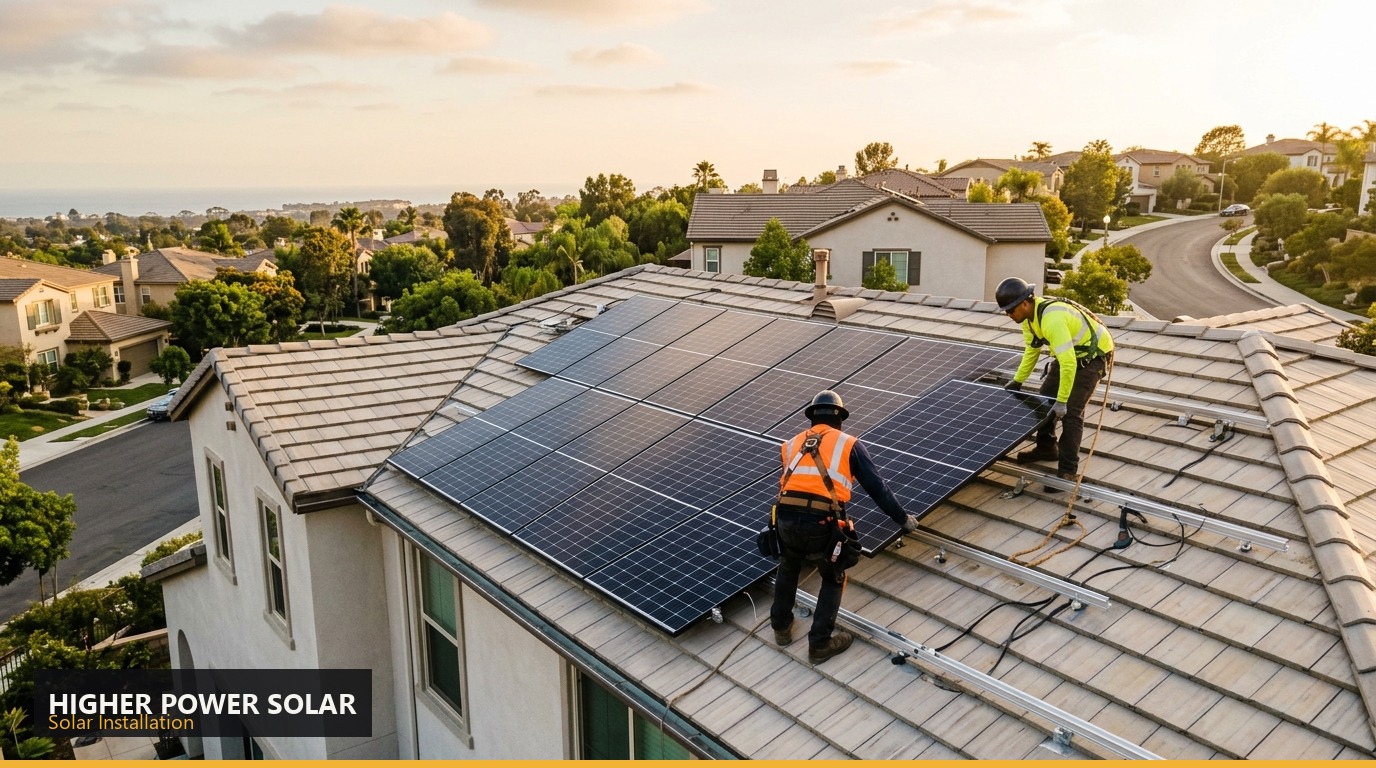
Solar installation is the design, permitting, and physical mounting of a photovoltaic system on your home or business — including the panels, inverter, racking, wiring, monitoring, and (almost always now) battery storage. Higher Power Solar designs, permits, and installs custom solar systems across Southwest Florida and Southern California. This page covers what the work actually involves, what it costs, how long it takes, and what to expect from start to finish.
Already have solar? See our guide to solar panel maintenance & cleaning.
What a solar installation includes
A complete residential solar installation has six functional components. Each one matters; understanding the role of each helps you evaluate proposals.
- Solar panels (PV modules)
- Monocrystalline silicon modules that convert sunlight to direct-current (DC) electricity. Modern residential panels are 400–450 watts each, with 25- to 30-year power-output warranties.
- Inverter
- Converts DC from the panels to alternating-current (AC) your home uses. Microinverters (Enphase IQ8) attach to each panel individually; string inverters serve the whole array from a single unit. Microinverters cost more but tolerate shade and partial failures better.
- Battery storage
- Optional but increasingly standard. A home battery (Tesla Powerwall, Enphase IQ Battery) stores midday solar production for evening use, runs essential loads during outages, and — in California — is essentially required for NEM 3.0 economics.
- Racking and mounting hardware
- Bolts the array to your roof. Material choice matters in Florida and coastal California: we use stainless-steel fasteners throughout because galvanized steel corrodes within a few years in salt air.
- Wiring, conduit, and main service panel work
- Carries DC from panels to inverter, AC from inverter to your main panel. Many older homes need a main panel upgrade (typically 100A or 125A → 200A) to support solar plus battery.
- Monitoring system
- An app (Enphase Enlighten, Tesla App, etc.) that shows real-time production, consumption, and battery state. Helps you verify the system is working and that your utility is crediting you correctly.
The installation process, start to finish
From signing the contract to receiving Permission to Operate (PTO) from the utility, expect 6–14 weeks. Here’s what happens in each phase.
| Phase | What happens | Typical duration |
|---|---|---|
| 1. Site survey | Technician walks your roof, photographs your main panel, takes measurements, checks shading. | 1–2 weeks after contract |
| 2. Engineering & design | Our team produces structural calcs, electrical one-line diagrams, and a final system layout. | 1–2 weeks |
| 3. Permitting | We file the building permit (and electrical, if separate) with your county or city. | 2–6 weeks (county backlog dependent) |
| 4. Installation | On-roof work plus electrical hookup. Most jobs are 1–3 days. | 1–3 days |
| 5. Inspection | City/county inspector verifies the install matches the permit. | 3–10 days after install |
| 6. Utility interconnection (PTO) | Utility issues Permission to Operate after reviewing the inspection. | 2–4 weeks |
What solar installation costs in 2026
Installed costs vary by system size, equipment quality, and whether you’re adding battery storage. The numbers below are typical gross installed costs in our service areas, before the 30% federal solar tax credit and any state incentives.
| System size | Typical home | Solar only (gross) | Solar + 1 battery (gross) | Solar + 2 batteries (gross) |
|---|---|---|---|---|
| 6 kW | 1,200–1,600 sq ft, modest load | $18,000–$24,000 | $28,000–$36,000 | $36,000–$45,000 |
| 8 kW | 1,800–2,400 sq ft, average load | $22,000–$30,000 | $33,000–$42,000 | $41,000–$52,000 |
| 10 kW | 2,400–3,000 sq ft, larger load | $28,000–$36,000 | $38,000–$48,000 | $47,000–$58,000 |
| 14 kW | 3,000+ sq ft, pool/EV/large home | $36,000–$48,000 | $47,000–$60,000 | $56,000–$70,000 |
After the 30% federal solar tax credit, subtract roughly $7,500–$15,000 from any of the above. California customers can stack SGIP battery rebates on top — see our California solar incentives guide. Florida customers get sales-tax exemption on solar equipment plus a property-tax exclusion (the system increases home value, but you don’t pay property tax on the increase). See our FPL cost per kWh explainer for what those savings actually look like on the bill side.
How to size your system
The right system size depends on three numbers: your last 12 months of utility bills (in kWh), your roof’s usable sun exposure, and your near-term plans (EV, pool, home addition). A solar designer pulls all three together. As a rough guideline:
| Annual kWh used | Recommended system size | Typical battery sizing |
|---|---|---|
| 8,000–10,000 kWh/year | 6–8 kW | 1 battery (10–13 kWh) |
| 10,000–14,000 kWh/year | 8–11 kW | 1–2 batteries |
| 14,000–20,000 kWh/year | 11–15 kW | 2 batteries |
| 20,000+ kWh/year (pool, EV, large home) | 15+ kW | 2–3 batteries |
Where Higher Power Solar installs
We install solar across Southwest Florida and Southern California, plus Las Vegas. Pick your city for installer details and local pricing specifics:
| Florida (Sarasota / Charlotte / Lee Counties) | California (San Diego County) | Nevada |
|---|---|---|
| North Port Port Charlotte Rotonda West Venice Punta Gorda Englewood Osprey Sanibel Fort Myers Fort Myers Shores Warm Mineral Springs | La Mesa Rancho Santa Fe Mira Mesa Clairemont Del Mar La Jolla Rancho Bernardo Santee | Las Vegas |
Frequently asked questions about solar installation
How long does a typical solar installation take from start to finish? The on-roof work is 1–3 days. The full process from contract signing to receiving Permission to Operate from your utility is 6–14 weeks depending on permit office backlog and utility interconnection queue.
Will solar work during a power outage? Grid-tied solar alone shuts off during outages for utility safety. Solar paired with a battery (Enphase IQ Battery or Tesla Powerwall) disconnects from the grid and powers essential loads from solar and stored capacity.
Do I need a roof inspection before installing solar? Yes — we evaluate the roof’s age and condition during the site survey. If your roof is within 5 years of needing replacement, we recommend doing both jobs together to avoid paying twice to remove and reinstall the array.
What size system do most homes need? Most single-family homes need 8–14 kW of solar to offset their full annual electric bill. The exact size depends on your last 12 months of usage, roof orientation, and shading.
Does Higher Power Solar work on metal, tile, and shingle roofs? Yes. We install on all common residential roof types. The mounting hardware differs (S-5! clamps for standing-seam metal, tile hooks for tile, flashed L-feet for shingle) but the system design and warranty are the same.
What financing options are available? Cash purchase, $0-down solar loans, leases, PPAs, and home equity options all work. See our solar financing options guide for a full breakdown of each.
Does the 30% federal solar tax credit apply to my install? Yes, if you purchase the system (cash or loan) and have federal tax liability to use it. The credit is 30% of total system cost through 2032, and applies to panels, inverter, battery, labor, permits, and the portion of roof costs structurally required to support the array.
Schedule a free in-home consultation
Florida: call (941) 830-4937. California / Nevada: call (619) 456-5352. We’ll review your last 12 months of utility bills, walk your roof, and design a system sized to your actual usage and goals. No high-pressure sales — just honest numbers.