
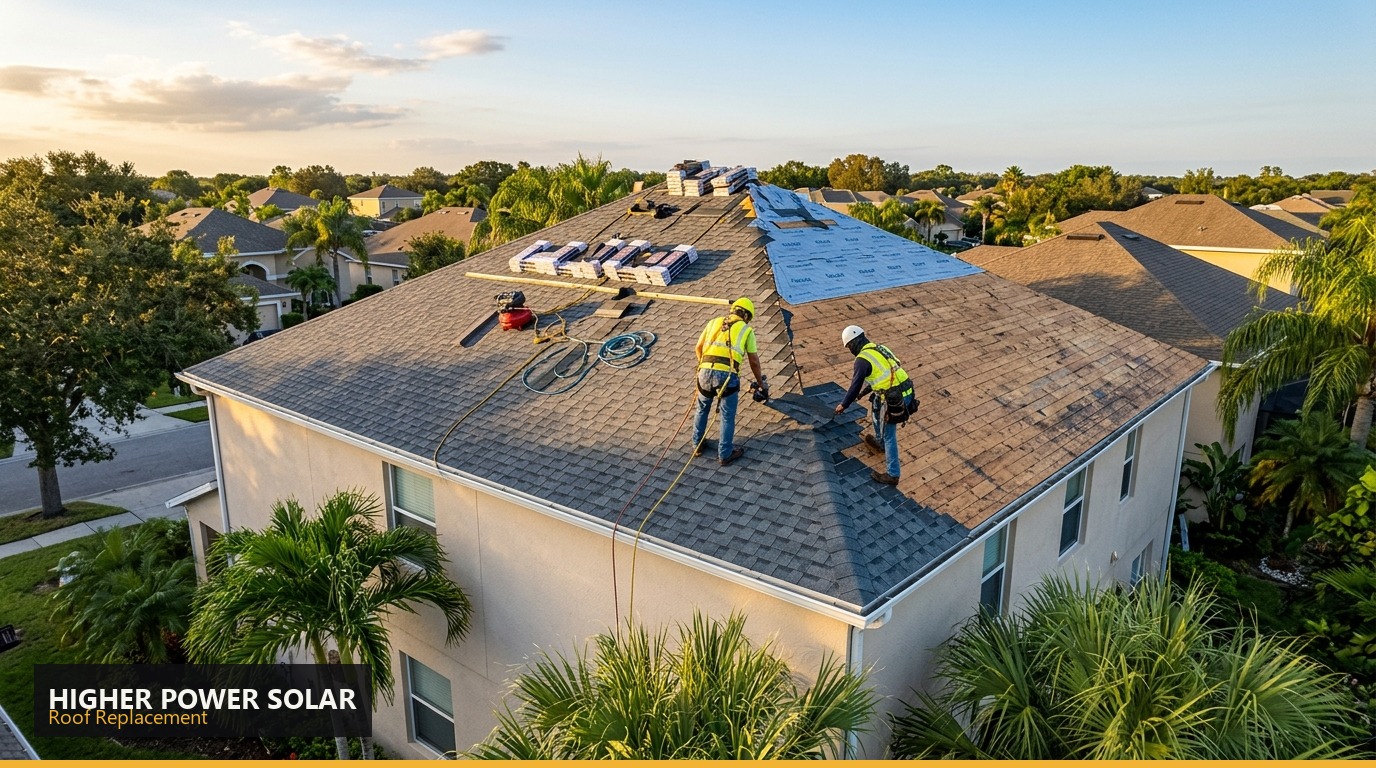
Higher Power Solar & Roofing handles full roof replacements across Southwest Florida — from tearing off the failing roof to final inspection — as a standalone service or paired with solar in a single project. This page covers when to replace versus repair, what each material costs, hurricane code requirements, the project timeline, and how to combine roofing with solar for the best long-term math.
Explore our full range of roofing services beyond replacement.
Considering a solar roof? See our solar shingles guide (cost, brands, vs panels).
Weighing a solar roof against panels? See Tesla Solar Roof vs. solar panels + a new roof — real 2026 costs and when each wins.
When to replace versus repair
- Asphalt shingle
- Typical service life is 20–25 years in Southwest Florida (heat, UV, and hurricane exposure accelerate aging). Replace at 20+ years or when granule loss, curling, or repeated leaks appear.
- Concrete or clay tile
- The tiles themselves often last 50+ years, but the underlayment beneath them typically fails at 25–30 years. If you have an original-era tile roof with underlayment past 25 years, plan replacement of the underlayment (and any cracked tiles) before the next major storm.
- Standing-seam metal
- 40–60 year service life. Replacement is rare; touch-ups and recoating are usually sufficient until significant rusting or seam failure.
- Membrane / TPO (flat roof)
- 15–25 year service life depending on UV exposure and quality of original install.
Roof material costs in Southwest Florida (2026)
| Material | Installed cost per sq ft | Typical 2,000 sq ft home | Expected service life |
|---|---|---|---|
| 3-tab asphalt shingle | $5–$8 | $10,000–$16,000 | 15–20 years |
| Architectural shingle (impact-rated) | $7–$12 | $14,000–$24,000 | 25–30 years |
| Standing-seam metal (24-gauge steel) | $12–$18 | $24,000–$36,000 | 40–60 years |
| Concrete tile (S-tile or flat) | $15–$22 | $30,000–$44,000 | 30–50 years |
| Clay tile (Spanish or barrel) | $18–$28 | $36,000–$56,000 | 50–100 years |
Prices include tear-off, new underlayment, flashing, ridge venting, and disposal. Permit fees are typically $300–$700 in addition. Insurance discounts often apply for impact-rated materials in hurricane zones.
Florida Building Code hurricane requirements
Every roof replacement in our service area must meet the Florida Building Code’s wind zone design speed for the specific address — typically 150 to 170 mph in Southwest Florida. This drives several material and installation requirements:
- Hurricane straps connecting roof rafters or trusses to the wall plates. Required for any roof replacement on homes built without them.
- Reinforced roof decking with the correct nailing pattern (typically 4″ perimeter, 6″ field with ring-shank nails). Many older homes had 6″/12″ patterns that no longer meet code.
- Self-adhered or “peel-and-stick” secondary water barrier required since the 2007 Florida Building Code update.
- Impact-rated shingles or metal panels recommended (and required by some insurers) for wind zones above 150 mph.
Project timeline — start to finish
| Phase | Duration | What happens |
|---|---|---|
| Inspection & quote | 1–3 days | Site visit, measure roof, photograph existing condition |
| Material order | 1–3 weeks | Order tile/shingle/metal (lead time varies by material) |
| Permit | 1–3 weeks | County or city permit (typically Charlotte, Sarasota, or Lee County) |
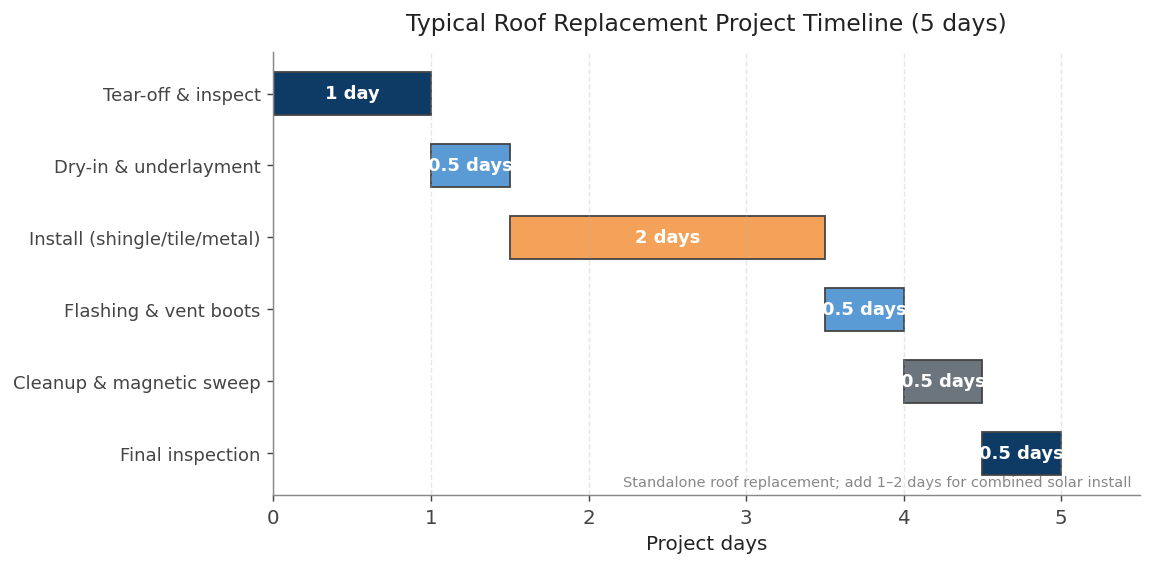
| Tear-off & install | 1–5 days | Most asphalt jobs are 1–2 days; tile and metal are 3–5 days |
| Inspection | 3–10 days | County inspector verifies code compliance |
| Total typical timeline | 4–8 weeks | Faster if material is in stock |
Why combine roof replacement with solar
If your roof is within 10 years of needing replacement and you’re considering solar, doing both in one project saves meaningfully on labor and avoids removing and reinstalling the array later. Specifically:
- One mobilization. A solar crew adding panels to a brand-new roof costs roughly $5,000–$8,000 less than a separate project later.
- One permit cycle. Combined roof + solar permits are pulled together, saving 2–4 weeks of duplicate paperwork.
- One unified warranty. No finger-pointing if there’s ever a leak under the solar array — same contractor handled both.
- Federal solar tax credit on the structurally required roof portion. The IRS allows the 30% solar ITC to apply to the share of the new roof that’s required to support the array (typically 20–40% of the roof). On a $30,000 roof + $25,000 solar project, that’s an extra $3,000–$3,600 of credit.
See our dedicated solar + roofing combined service page for the full breakdown.
Where Higher Power Solar & Roofing replaces roofs
Frequently asked questions
Do I need to leave home during a roof replacement? No. Most homeowners stay home; the work is on the roof and minimally invasive inside. Pets should be kept indoors or boarded for noise.
Will insurance pay for my roof replacement after a hurricane? Often yes if the damage is documented and the roof was less than 10 years old at the time of the storm. We can coordinate directly with your adjuster.
How long until I can drive on my driveway after a roof install? Immediately — we tarp the driveway and use ladder-mounted material lifts to avoid driveway damage in most cases.
What about my solar panels if I already have them? If you have existing solar, the panels must be removed, the roof replaced, and the panels reinstalled. Budget $3,000–$5,000 for the remove-and-reinstall labor in addition to the roof cost. This is why we recommend combining the projects when possible.
Do you handle insurance claims? We coordinate with your adjuster and provide all documentation, but the claim itself stays between you and your insurer.
Free roof inspection and quote
Call (941) 830-4937 for a free in-home consultation. Our technician walks your roof, photographs each elevation, identifies any underlying structural concerns, and provides an itemized quote with material options.