
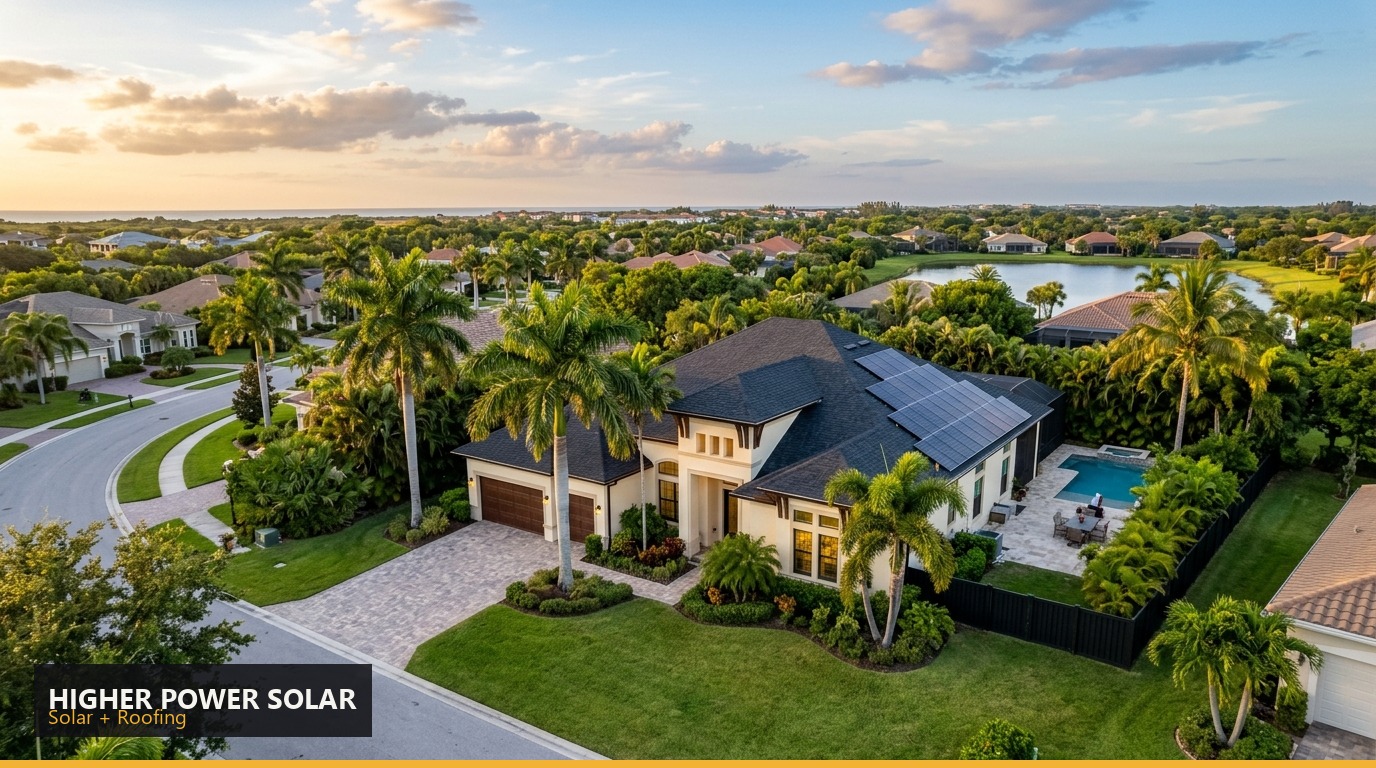
Higher Power Solar & Roofing is one of the few Southwest Florida contractors licensed to handle both solar installation and full roof replacement as a single combined project. This page covers why the combined service is the smart play for any homeowner whose roof is approaching replacement age, what the combined cost looks like, the tax credit math that makes it work, and the practical project flow.
See all our roofing services (replacement, repair, metal, tile) across Southwest Florida.
Weighing a solar roof against panels? See Tesla Solar Roof vs. solar panels + a new roof — real 2026 costs and when each wins.
Why combine solar with roof replacement?
- One mobilization, one labor crew
- Adding solar to a brand-new roof saves $5,000–$8,000 compared to a separate solar project later — the crew is already on site, the dump trailer is staged, the permit is open. Doing both at once amortizes the setup cost.
- One permit cycle
- Combined roof + solar permits are pulled together. You avoid pulling a roof permit now and a solar permit a year later, with separate inspection scheduling and county fees.
- One unified workmanship warranty
- If a leak ever develops under the solar array, you call one contractor. No finger-pointing between “the roofer’s flashing” and “the solar installer’s penetrations” — both are us.
- 30% federal solar tax credit on the structurally required roof portion
- The IRS allows the solar ITC to apply to the share of the roof that’s structurally required to support the array. On a typical project, that’s 20–40% of the roof. The combined project unlocks credit dollars that a separated project doesn’t.
Combined cost — what you actually pay
| Home size | Roof replacement (architectural shingle) | Solar (10 kW + battery) | Combined gross | After 30% ITC on solar + qualifying roof |
|---|---|---|---|---|
| 1,500 sq ft | $13,000 | $32,000 | $45,000 | ~$32,400 net |
| 2,000 sq ft | $18,000 | $38,000 | $56,000 | ~$40,000 net |
| 2,500 sq ft | $22,000 | $42,000 | $64,000 | ~$45,500 net |
| 3,000+ sq ft | $28,000 | $48,000 | $76,000 | ~$54,000 net |
Net cost assumes the 30% federal ITC applies to the full solar cost plus approximately 30% of the roof cost (the structurally required share). Actual percentage varies by project; we calculate it specifically for your home.
When the combined project makes sense
- Your roof is 15+ years old (asphalt) or 25+ years old (tile underlayment). You’re going to replace within the next 5 years anyway. Combining now saves the future remove-and-reinstall labor.
- You’re rebuilding after Hurricane Ian, Milton, or another major storm. The roof is already being replaced — adding solar at this moment captures the once-per-30-years opportunity.
- You’re considering selling within 5–10 years. Homes with new roofs + owned solar sell faster and command higher prices than homes with either alone.
- You want a single contractor accountable for everything above the rafters. One warranty, one phone number, one project manager.
The project flow
| Step | Duration | Notes |
|---|---|---|
| 1. Combined site survey | 1–2 hours | Roof inspection + electrical panel assessment + roof measurements for solar layout |
| 2. Engineering & material order | 2–4 weeks | Solar layout, structural calcs, roofing material order, electrical one-line diagram |
| 3. Combined permit submission | 1–3 weeks | Roof and solar permits filed together with the county building department |
| 4. Roof replacement | 1–5 days | Tear-off, new underlayment, install new roof material |
| 5. Solar install | 1–3 days, immediately after roof | Mount, wire, connect to existing or new main panel |
| 6. Combined inspection | 3–10 days | County inspector verifies both |
| 7. Utility interconnection (PTO) | 2–4 weeks | Utility issues Permission to Operate for the solar system |
| Total typical timeline | 8–14 weeks | Faster than two separate projects (which would be ~6 months end-to-end) |
Materials we recommend for combined projects
- Best long-term combo: standing-seam metal roof + solar. Metal lasts 40–60 years; solar mounts via S-5! clamps with zero roof penetration. The array will likely come down and go back up never. Higher upfront cost; lowest 30-year total cost.
- Best value combo: impact-rated architectural shingle + solar. 25–30 year shingle service life matches solar’s expected output life. Standard flashed L-foot mounting. Mid-range upfront cost; good total economics.
- Tile-roof combo: if your home was designed for tile, we re-tile and use specialized tile hooks. More expensive than shingle but maintains the home’s architectural character.
Where Higher Power Solar & Roofing handles combined projects
Frequently asked questions
Does my homeowner’s insurance pay for any of this? If your roof is being replaced due to storm damage, insurance typically covers the roof portion (minus deductible). Solar is separate and not generally covered. We coordinate the insurance side of the roof claim.
What if my roof has only 5 years of life left? Combine. The math is almost always better than doing solar now and roof in 5 years.
What if my roof is brand new? Don’t combine — just add solar. We install on roofs of any age; new roofs are actually the easiest because we don’t have to plan around a future replacement.
How does the 30% solar tax credit apply to the roof? The IRS guidance (Notice 2013-29 and subsequent) allows the credit to apply to the portion of the roof that is structurally required to support the solar array — typically the area directly under the array plus supporting framing. We calculate the specific qualifying percentage for your project and provide documentation for your tax preparer.
Can I finance the combined project? Yes. Solar-specific financing is the usual route — most lenders will finance the full combined cost (solar + roof + battery) at solar rates because the project is treated as solar-primary.
Schedule a free combined-project consultation
Call (941) 830-4937 to schedule a combined site survey. One technician inspects both your roof and your electrical panel, photographs each elevation, and provides a single itemized quote covering roof + solar + battery (if applicable) — with the tax credit math worked through for your specific home.