
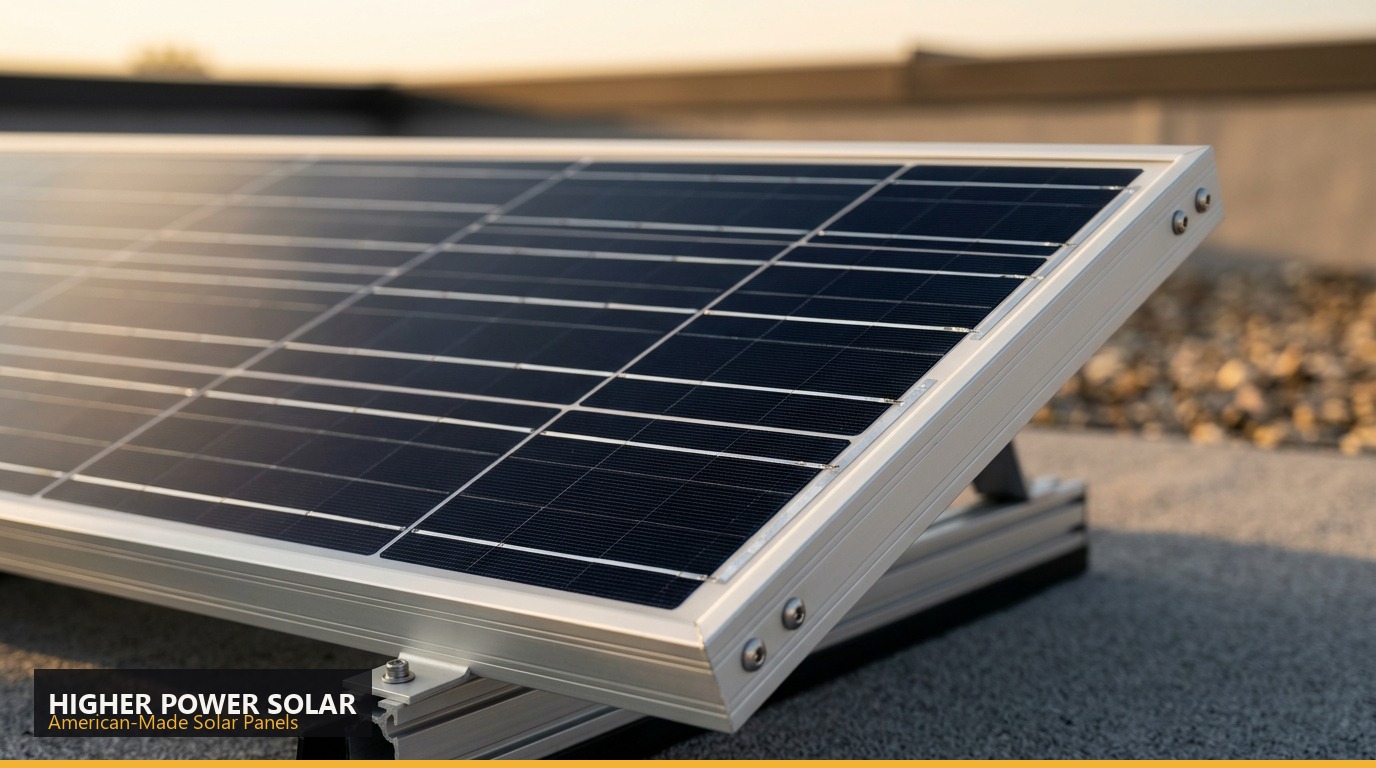
American-made solar panels matter for three reasons in 2026: the Inflation Reduction Act’s domestic-content bonus credit, supply-chain reliability after the 2022–2024 tariff turbulence, and the warranty support that comes with a US-based manufacturer. This guide covers which residential solar panel brands actually manufacture in the United States, what the IRA bonus credit looks like, and which brands Higher Power Solar installs.
Why buy American-made solar panels in 2026
- Domestic-content bonus credit (Inflation Reduction Act)
- The IRA added a 10% bonus federal tax credit on top of the existing 30% ITC for solar projects that meet domestic-content thresholds — meaning your tax credit can climb to 40% if the panels and inverter qualify. For a typical 10 kW system, that turns a $7,500 credit into a $10,000 credit. The IRS has clarified domestic-content rules for residential through 2026 guidance.
- Warranty enforceability
- If your panel manufacturer is based overseas and goes through bankruptcy or pulls out of the US market (which happened with several brands in 2023–2024), your 25-year warranty becomes hard to enforce. American-made brands with US-based corporate operations are easier to make warranty claims against.
- Tariff resilience
- US tariffs on solar panels from China, Cambodia, Vietnam, Malaysia, and Thailand have driven volatility in installed prices. Panels manufactured domestically avoid these tariffs entirely and tend to have more stable wholesale pricing.
- Supply chain ethics
- The Uyghur Forced Labor Prevention Act (UFLPA) targets polysilicon sourced from the Xinjiang region. Several major Chinese panel brands have had US shipments held at customs under UFLPA in 2023–2025. American-made or US-assembled brands largely avoid this risk.
Top American-made solar panel brands in 2026
| Brand | US manufacturing location | Typical efficiency | Product warranty | Performance warranty |
|---|---|---|---|---|
| Q CELLS (Hanwha Q CELLS America) | Dalton, Georgia | 20.0–21.7% | 25 years | 25 years, 86% retained |
| Silfab Solar | Burlington, Washington (parent in Toronto) | 20.4–22.1% | 25 years | 30 years, 82.6% retained |
| Mission Solar | San Antonio, Texas | 19.4–20.5% | 25 years | 25 years, 84% retained |
| JinkoSolar (US) | Jacksonville, Florida (assembly) | 21.1–22.4% | 25 years | 30 years, 87.4% retained |
| First Solar | Perrysburg, Ohio | 18.6–19.5% (thin-film) | 25 years | 25 years, 86% retained |
| Heliene | Mountain Iron, Minnesota | 19.6–21.2% | 15 years | 30 years, 82% retained |
| Solar4America | Sacramento, California | 20.5–21.4% | 25 years | 25 years, 85% retained |
Efficiency numbers above are for the brands’ residential mainline panels — premium “Black on Black” or “All Black” variants are typically at the high end of each range.
Which American-made brands Higher Power Solar installs
We primarily install two American-made brands across Florida, California, and Nevada:
- Q CELLS (Q.PEAK DUO BLK-G10+ series) — manufactured in Dalton, Georgia. Our default mainline panel. Excellent low-light performance and a 25-year all-black aesthetic that HOAs and architectural review boards approve readily.
- Silfab Solar (SIL-440 NX BG series) — manufactured in Burlington, Washington. Premium option with a 30-year performance warranty and slightly higher efficiency. Used on premium installs where customers want the longest warranty available.
Both qualify for the IRA domestic-content bonus credit when paired with an American-made inverter (Enphase IQ8 series microinverters, manufactured in Mexico but qualified under USMCA, or US-made SolarEdge Home Hub inverters).
How the domestic-content bonus credit works
To claim the additional 10% bonus on top of the 30% federal ITC, a project must meet:
- 100% of all structural steel/iron must be US-produced (racking and ground-mount components)
- A minimum percentage of total manufactured-product cost must be US-produced — 40% in 2024, rising annually
Most residential rooftop installs using Q CELLS or Silfab panels plus US-assembled racking (IronRidge, Unirac) plus Enphase microinverters meet the threshold. Your installer should provide a domestic-content certification with your tax-credit paperwork.
Cost premium for American-made panels
| Panel type | Approx. price premium vs. overseas equivalent | 10 kW system cost impact |
|---|---|---|
| Q CELLS (Georgia) | +$0.10/watt | +$1,000 gross / +$700 net of ITC |
| Silfab (Washington) | +$0.20/watt | +$2,000 gross / +$1,400 net of ITC |
| Heliene / Mission Solar | +$0.05–$0.10/watt | +$500–$1,000 gross |
Once the 10% domestic-content bonus credit is applied (extra ~$2,500–$3,000 on a typical 10 kW system), the net cost of American-made panels often becomes lower than imported panels.
Tariff and trade policy context
Three policy layers affect imported solar panels in 2026:
- Section 201 tariffs
- Bifacial-panel exemption was removed in 2022. Current tariff rate is approximately 14.25% on most imported panels.
- Section 301 tariffs (China specifically)
- 25% tariff on Chinese-origin solar panels.
- Antidumping/countervailing duties (Cambodia, Vietnam, Malaysia, Thailand)
- New duties applied starting late 2024 after the Department of Commerce ruled these countries’ panels were predominantly Chinese-component assembly. Rates range from 21% to over 270% on specific manufacturers.
The cumulative effect is that imported panels now cost approximately 15–30% more at the wholesale level than they did pre-2024. American-made panels avoid all three layers, which is why the price premium has narrowed substantially.
Frequently asked questions
Are SunPower panels American-made? SunPower is US-headquartered (Richmond, California) but their panels have historically been manufactured in Mexico and the Philippines. Recent restructuring has moved some production back to the US but SunPower panels do not consistently qualify for the IRA domestic-content bonus credit.
Are Tesla solar panels American-made? Tesla’s Solar Roof tiles are manufactured at the Tesla factory in Buffalo, New York. Tesla retail solar panels (the standard rooftop modules they sell) are sourced from Hanwha Q CELLS and Panasonic and assembled in Asia.
Do American-made panels last longer? Not inherently. Panel longevity is driven by manufacturing quality control and warranty terms, not country of origin. American-made brands generally offer slightly longer warranties (Silfab 30-year performance vs. typical 25-year), which suggests confidence in longevity.
Will I see a SunPower vs. Q CELLS efficiency difference? SunPower’s premium Maxeon-series panels rate slightly higher in efficiency (22.8%) than Q CELLS’ best (21.7%). The real-world annual production difference is roughly 4–5% — meaningful but not transformative.
Does Higher Power Solar charge more for American-made? Yes, but the IRA domestic-content bonus credit typically offsets the premium entirely — you end up paying about the same or slightly less than imported panels after credits.
Get a quote with American-made panels
Higher Power Solar installs Q CELLS (Georgia) and Silfab (Washington) as standard offerings. Both qualify for the 30% federal ITC and most installs qualify for the 10% domestic-content bonus credit. Call (619) 456-5352 or request a free in-home quote with a detailed equipment specification.
Related solar topics
- Solar panel cost 2026 — installed prices by state and system size
- Solar installation guide — the full process from contract to PTO
- Tesla Powerwall cost — battery pricing and alternatives
- California solar incentives — NEM 3.0 and SGIP details
- FPL cost per kWh — Florida rate structure