
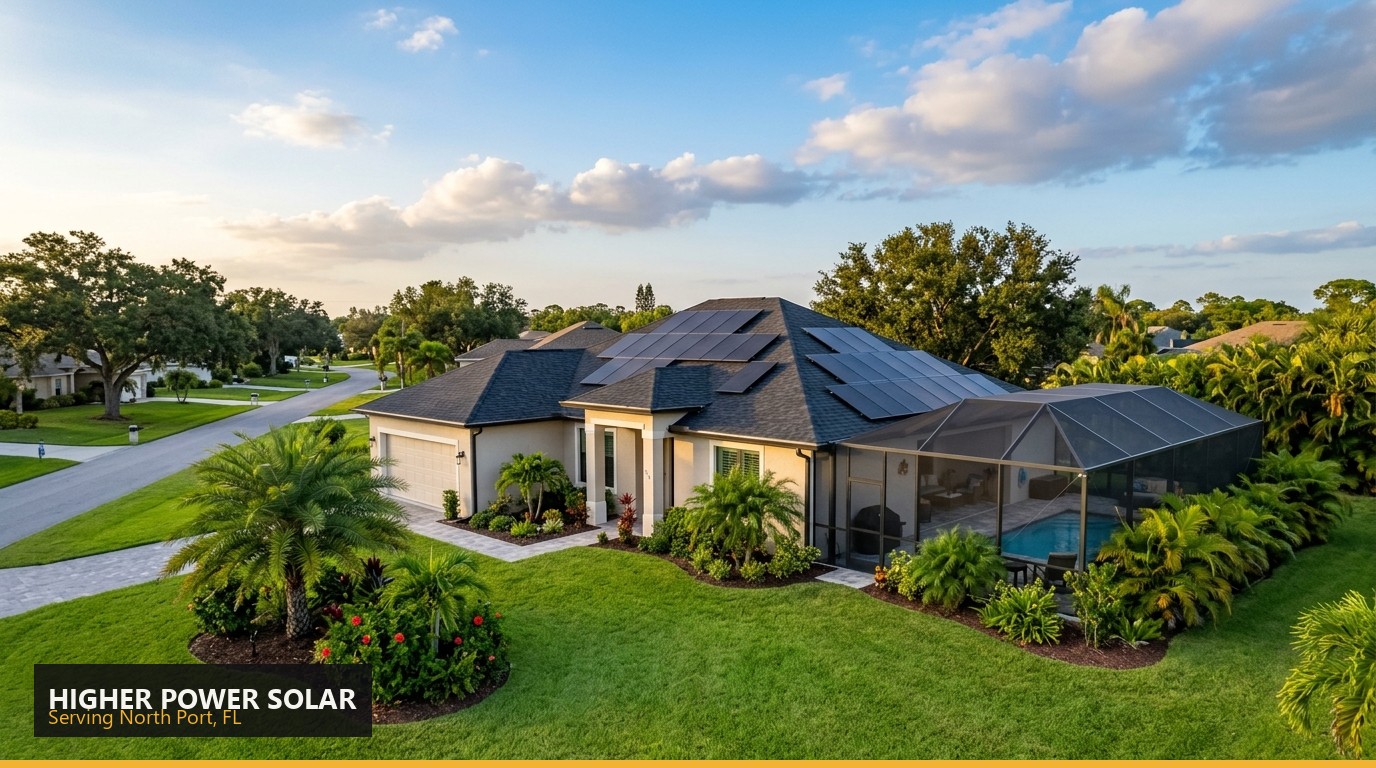
If you’re pricing solar panels in North Port, FL, the math is simpler than most sales pitches make it sound: FPL charges roughly $0.15–$0.18 per kilowatt-hour once every surcharge is added up, North Port runs its air conditioning most of the year, and Florida still credits the solar you export at the full retail rate. This page covers what solar panels cost in North Port in 2026, what actually moves the price, how FPL net metering works, and what a hurricane-rated install looks like — from a company that’s a licensed roofer and solar installer here in Southwest Florida. No pressure, just numbers you can check.
Why solar panels pay off in North Port, Florida
Three things make North Port one of the stronger solar markets in the country:
- FPL rates keep climbing. The all-in FPL rate is roughly $0.15–$0.18 per kWh once fuel, storm-recovery, and other surcharges stack on the base rate — and FPL has filed for additional base-rate increases in 2026. Full breakdown in our FPL cost per kWh guide.
- A long cooling season. The typical Florida electric bill runs $130–$180 a month, and most of that is air conditioning. The more you run the AC, the more every solar kilowatt-hour is worth.
- 1:1 net metering — still. FPL currently credits residential solar exports at the full retail rate, so your midday production offsets your evening usage one for one.
Put together: a typical 10 kW system in Sarasota or Charlotte County produces roughly 13,000–15,000 kWh a year — about $1,950–$2,700 a year off your FPL bill at today’s rates. Stack the 30% federal solar tax credit (extended through 2032), Florida’s sales-tax exemption on solar equipment, and Florida’s property-tax exclusion on the added home value, and most North Port systems pay for themselves in 6–9 years — then keep producing for 20+ more.
What solar panels cost in North Port in 2026
The honest answer: it depends on your usage, your roof, and your electrical panel — which is why any company quoting a price before seeing your last 12 months of FPL bills is guessing. These are the factors that actually move a North Port solar quote:
- System size. We size from your actual FPL usage, not your square footage. A bigger cooling load means a bigger system — and a bigger payoff per panel at FPL’s rates.
- Roof type and condition. Shingle and tile mount differently, and a roof near the end of its life should be replaced before panels go on. As a licensed roofer and solar installer, we handle both as one project instead of two contractors pointing at each other.
- Main electrical panel. Homes built before the 2000s often have 100A or 125A panels that need a service upgrade — typically $2,500–$5,000. It’s the single biggest cost surprise in solar quotes, so we check it at the site survey, not after you’ve signed.
- Permits and inspection. In Florida these typically run $300–$700, and they’re included in a legitimate quote — not a surprise line item later.
- Battery backup (optional). Adding a Tesla Powerwall 3 to a new solar install runs roughly $9,000–$12,000 incremental, and the 30% federal credit applies to the battery too when it’s installed with solar.
Every quote we write itemizes each of these and shows the cash and financed numbers side by side. Hold any bidder on your roof to the same standard.
Solar only vs. solar + battery in North Port
Because FPL still runs 1:1 net metering, a battery in North Port isn’t about bill savings the way it is in California — the grid already “stores” your excess production for free. Here, the battery is hurricane insurance. Compare:
| Solar only | Solar + battery | |
|---|---|---|
| FPL bill offset | Full offset of per-kWh charges via 1:1 net metering | Same |
| During an FPL outage | System shuts down (required by safety code) | Essentials keep running on solar + stored power |
| Hurricane season | No backup | Multi-day essentials backup — 20–27 kWh (two units) is the recommended size for hurricane-prone Florida |
| Typical added cost | — | Powerwall 3 roughly $9,000–$12,000 incremental on a new solar install |
| 30% federal tax credit | Applies | Applies to the battery too when installed with solar |
Sizing, brands, and real installed prices are in our battery backup guide and Tesla Powerwall cost breakdown.
FPL net metering in North Port: how the credit works
Your panels produce the most at midday, when you’re using the least. Under FPL’s current net metering rules, the kilowatt-hours you export flow to the grid and come back as a one-for-one retail credit against the kilowatt-hours you pull in the evening, within the monthly billing cycle. One thing solar does not offset: FPL’s flat customer charge of roughly $10–$25 a month, which you pay even at zero usage — so a fully offset home still sees a small minimum bill. That’s normal and expected. Florida’s 1:1 rules are the best version of net metering left in the country; states like California have already cut theirs. That’s not a promise the rules last forever — it’s the argument for running your numbers now instead of later.
Hurricane wind and North Port roofs
After Hurricane Ian, it’s the first question every North Port homeowner asks — and it deserves a straight answer. Solar installs here are engineered, permitted, and inspected to Florida’s wind-zone requirements: racking anchored into the roof structure, not just the decking, with every penetration flashed and sealed. Because we’re a licensed roofer as well as a solar installer, the roof and the array get assessed as one system — if your shingles won’t outlast the panels, we tell you before the install, not after the first storm. Worth remembering: the storm-recovery surcharge on your FPL bill means you’re already paying for hurricanes every month. Solar with hurricane-rated mounting is how you get something back.
Solar permits in the City of North Port
Rooftop solar in North Port is permitted through the City of North Port building department, in Sarasota County, and the finished system is inspected before it operates. In Florida the permit and inspection typically run $300–$700. We pull the permit, schedule the inspection, and file the FPL interconnection paperwork so the utility approves the system for operation — you don’t chase the city or the utility yourself. If a company asks you to handle “the paperwork,” that’s your cue to keep shopping.
Battery backup for North Port outages
Southwest Florida sees the largest outages of any region in the state — Hurricane Ian left some neighborhoods without power for weeks. A grid-tied solar system alone shuts down during an outage (safety code: your panels can’t back-feed lines crews may be working on). Pair it with a battery and the system disconnects from the grid and keeps your essentials running — refrigerator, internet, lights, one AC zone — recharging from the sun each day. For hurricane-prone Florida we recommend 20–27 kWh of storage (two battery units) for two to three days of essentials. We install Tesla Powerwall, Enphase IQ Battery, and FranklinWH systems across Southwest Florida.
What solar panel installation in North Port looks like
- Bill review. We pull your last 12 months of FPL usage — the real number a system should be sized from.
- Roof inspection. Shingle or tile condition, structure, shading, and whether the roof will outlast the panels.
- Written design and quote. Equipment named brand-by-brand, cash and financed numbers side by side, every cost factor itemized.
- Permit. Filed with the City of North Port building department — we handle it.
- Install and inspection. We install; the city inspects.
- FPL interconnection. We file the paperwork; once FPL approves, the system turns on and the net metering credit starts.
After that, our workmanship warranty covers the install — a solar system is a 25-year asset, and the company behind it should plan to be around that long.
Serving North Port, Port Charlotte & Southwest Florida
Our North Port office is at 3359 Oceanside St — details, directions, and the qualification form are on our North Port page. We install across Southwest Florida, including Warm Mineral Springs, Venice, Englewood, and Punta Gorda. Comparing Port Charlotte solar providers? We’re just across the county line — see our Port Charlotte page for that side of the Myakka.
North Port solar panel FAQs
How much do solar panels cost in North Port?
It depends on your FPL usage, roof, and electrical panel — the honest number comes from your last 12 months of bills, not a phone estimate. The 30% federal tax credit and Florida’s sales-tax exemption apply either way, and at FPL’s current rates most systems pay back in 6–9 years.
Is net metering still available in North Port?
Yes. FPL currently credits residential solar exports at the full 1:1 retail rate within the monthly billing cycle — among the best net metering terms left in the country.
Will solar panels survive a hurricane in North Port?
Installs are engineered, permitted, and inspected to Florida’s wind-zone requirements, with racking anchored into the roof structure. Note that a solar-only system shuts down during a grid outage — add a battery if you want power while FPL rebuilds.
Do I need a permit to install solar panels in North Port?
Yes — through the City of North Port building department, with an inspection before the system operates. Permits and inspection typically run $300–$700 in Florida, and we handle the whole process including FPL interconnection.
How much will solar save on my FPL bill?
A typical 10 kW system in Sarasota or Charlotte County produces 13,000–15,000 kWh a year — about $1,950–$2,700 in annual offset at FPL’s all-in rates. The flat customer charge (roughly $10–$25 a month) remains, so expect a small minimum bill rather than zero.
Get a North Port solar quote you can check
Call (941) 830-4937 for a free consultation. We’ll pull your last 12 months of FPL usage, inspect the roof, and give you a written, itemized quote you can hold against every claim on this page — equipment, permits, panel upgrade, and the net metering math. If the numbers don’t work for your house, we’ll tell you that too.